
جميع الكتب

مهني

1 Markets I: The Ecosystem and Exchange-Traded Marketsالأسواق عبر الإنترنت 2 Markets II: Rates, FX and Creditالأسواق عبر الإنترنت 3 Markets III: Commodities, Energy and Cryptoالأسواق عبر الإنترنت 4 Quantitative Methodsالأساليب عبر الإنترنت 5 Derivatives and Volatilityالمشتقات عبر الإنترنت 6 Rates, Credit, XVA and Riskالفائدة والائتمان والمخاطر عبر الإنترنت 7 Research Craft: Predictors, Backtests, Measurement, Portfoliosالبحث عبر الإنترنت 8 Strategies I: Equities and Futuresالاستراتيجيات عبر الإنترنت 9 Strategies II: Volatility, Relative Value, Macro and the Bank Desksالاستراتيجيات عبر الإنترنت 10 Microstructure and Executionالتنفيذ عبر الإنترنت 11 Market Making and High-Frequency Tradingصناعة السوق عبر الإنترنت 12 Machine Learning for Marketsتعلم الآلة عبر الإنترنت 13 Low-Latency Softwareالتكنولوجيا عبر الإنترنت 14 Networks, Hardware and Trading Infrastructureالتكنولوجيا عبر الإنترنت 15 Research, Data and Risk Platformsالتكنولوجيا عبر الإنترنت 16 The Desk and the Firmالشركة عبر الإنترنت 17 The Industry: Firms, Roles and Careersالمسارات المهنية عبر الإنترنت 18 The Interview Bookالمسارات المهنية عبر الإنترنت
التطبيقات حول المدرب تسجيل الدخول ابدأ القراءة

Quantitative Finance · المسرد

ما معنى Shared order book, implicit continuous allocation؟

يُعرف أيضًا باسم: shared order book · implicit continuous allocation

Definition 26.1 Networks, Hardware and Trading Infrastructure · الفصل 26 — Power, Commodities and Betting Connectivity

A shared order book is one order book that several market operators feed with their participants’ orders, so that an order entered with one operator can match an order entered with another. Implicit continuous allocation is the allocation of cross-border transmission capacity at the moment two orders in different bidding zones match, with the capacity and the energy priced together and the capacity used by the trade removed at once from what the next trade can use.
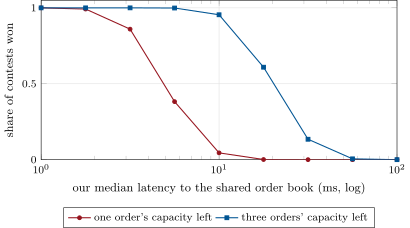
Simulation: the firm’s share of the scarce cross-border capacity against its median latency to the shared order book, racing five rivals at 5, 10, 20, 40 and 80\, m s. With one order’s capacity left, the share falls from 98.5% at 2\, m s to 4.5% at 10\, m s; with three, it holds 95.4% at 10\, m s. Data: fig_power.py, nw_power.share_curve().
Figure 26.1. Simulation: the firm’s share of the scarce cross-border capacity against its median latency to the shared order book, racing five rivals at 5, 10, 20, 40 and 80 ms80\,\mathrm{m}\mathrm{s}. With one order’s capacity left, the share falls from 98.5% at 2 ms2\,\mathrm{m}\mathrm{s} to 4.5% at 10 ms10\,\mathrm{m}\mathrm{s}; with three, it holds 95.4% at 10 ms10\,\mathrm{m}\mathrm{s}. Data: fig_power.py, nw_power.share_curve().
اقرأ في الفصل →