
全部书籍

专业

应用 关于 Coach 登录 开始阅读

书籍暂未推出简体中文版——当前显示英文版。

Economics · 术语表

什么是 Alternating-offers bargaining model?

Definition 12.11 University Economics — Year 2 · 第 12 章 — Dynamic Games

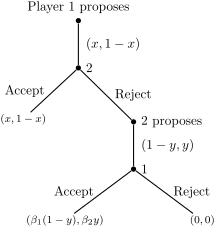
In the alternating-offers bargaining model two players divide a pie of size 1. In round 1 player 1 proposes a division and player 2 accepts or rejects it; after a rejection, player 2 proposes in round 2 and player 1 responds, and so on. A share ss agreed in round tt is worth βi t−1s\beta_i^{\,t-1} s to player ii, with 0<βi<10 < \beta_i < 1. Bargaining may end after a fixed number of rounds, with nothing for either player, or go on without limit.
Alternating offers with two rounds. Player 1 proposes a division, which player 2 accepts or rejects; after a rejection player 2 proposes and player 1 responds. Payoffs are valued in round 1: a share received in round 2 is discounted by each player’s _i. Backward induction: in round 2 player 2 offers y = 1, which player 1 accepts (or is indifferent about); so in round 1 player 2 accepts any 1 - x _2, and player 1 offers x = 1 - _2.
Alternating offers with two rounds. Player 1 proposes a division, which player 2 accepts or rejects; after a rejection player 2 proposes and player 1 responds. Payoffs are valued in round 1: a share received in round 2 is discounted by each player’s βi\beta_i. Backward induction: in round 2 player 2 offers y=1y = 1, which player 1 accepts (or is indifferent about); so in round 1 player 2 accepts any 1−x≥β21 - x \ge \beta_2, and player 1 offers x=1−β2x = 1 - \beta_2.
在原文中阅读 →