
All books

Professional

Apps About Coach Log in Start reading

Chemistry · Glossary

What is Nucleotides?

Also known as: nucleobase · nucleoside · nucleotide · phosphodiester bond

Definition 30.16 University Chemistry — Year 2 · Chapter 30 — Biomolecules: Amino Acids, Sugars, Lipids and Nucleotides

A nucleobase is a nitrogen heterocycle: adenine (A) and guanine (G), purines; cytosine (C), thymine (T) and uracil (U), pyrimidines. A nucleoside is a nucleobase bonded by a nitrogen to C1 of ribose or 2-deoxyribose (an NN-glycoside). A nucleotide is a phosphate ester of a nucleoside. In nucleic acids the nucleotides are joined by phosphodiester bonds: one phosphate links O3 of one sugar to O5 of the next.
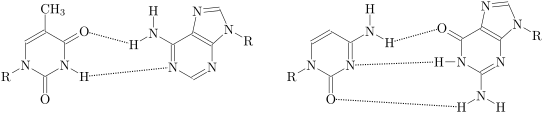
The two base pairs of DNA. Left: thymine and adenine, two hydrogen bonds (dotted). Right: cytosine and guanine, three. R is the deoxyribose of each strand; the two R groups of a pair point to the same side, towards the two backbones.
Read in context →