
All books

Professional

Apps About Coach Log in Start reading

Chemistry · Glossary

What is Route architecture?

Also known as: linear synthesis · convergent synthesis · longest linear sequence · overall yield

Definition 30.2 University Chemistry — Year 3 · Chapter 30 — Total Synthesis: Strategy and Classic Routes

In a linear synthesis each step acts on the product of the one before; in a convergent synthesis separate fragments are made in parallel and joined late. The longest linear sequence (LLS) is the largest number of steps from any starting material to the target. The overall yield is the amount of target obtained divided by the amount of the limiting starting material.
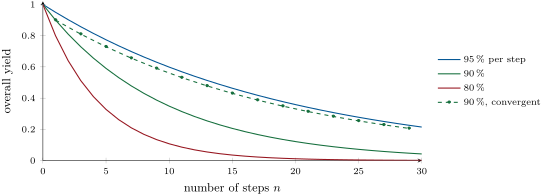
Overall yield against the number of steps for three yields per step (solid: linear routes), and for convergent routes at 90 % per step (two equal branches joined in a last step; dashed). Twenty steps at 90 % leave 12 %; the same steps arranged convergently leave about three times more.
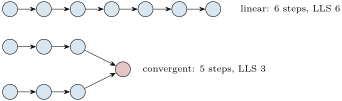
Route trees: each circle is a compound, each arrow a step. A linear route passes all its material through every step; a convergent one makes two fragments side by side and couples them, so that its longest linear sequence is shorter.
Read in context →