Todos os livros

Profissional

Apps Sobre Coach Entrar Começar a ler

Computer Science · Glossário

O que é Entropy, information gain?

Também chamado de: entropy · information gain

Definition 29.9 University Computer Science — Year 2 · Capítulo 29 — Learning from Examples: Decision Trees and Clustering

The entropy of a finite probability distribution (p1,…,pm)(p_1, \dots, p_m) is H=−∑ipilog⁡2piH = -\sum_i p_i \log_2 p_i, with 0log⁡20=00 \log_2 0 = 0; the entropy of a set of labelled examples is that of the frequencies of its labels. A split of a set SS into S1S_1 and S2S_2 has information gain

G=H(S)−∣S1∣∣S∣H(S1)−∣S2∣∣S∣H(S2).G = H(S) - \frac{|S_1|}{|S|} H(S_1) - \frac{|S_2|}{|S|} H(S_2).
The entropy of two labels, h(p) = -p _2 p - (1 - p) _2(1 - p). A set with 40~\% late loans split into halves with 10~\% and 70~\%: the average entropy of the parts, on the chord, lies below the entropy of the whole, on the curve. The dotted gap is the gain.
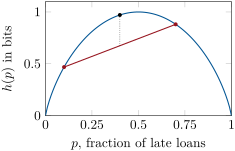
The entropy of two labels, h(p)=−plog⁡2p−(1−p)log⁡2(1−p)h(p) = -p \log_2 p - (1 - p) \log_2(1 - p). A set with 40 %40~\% late loans split into halves with 10 %10~\% and 70 %70~\%: the average entropy of the parts, on the chord, lies below the entropy of the whole, on the curve. The dotted gap is the gain.
Ler no capítulo →