全部书籍

专业

应用 关于 Coach 登录 开始阅读

书籍暂未推出简体中文版——当前显示英文版。

Computer Science · 术语表

什么是 Entropy, information gain?

又称: entropy · information gain

Definition 29.9 University Computer Science — Year 2 · 第 29 章 — Learning from Examples: Decision Trees and Clustering

The entropy of a finite probability distribution (p1,…,pm)(p_1, \dots, p_m) is H=−∑ipilog⁡2piH = -\sum_i p_i \log_2 p_i, with 0log⁡20=00 \log_2 0 = 0; the entropy of a set of labelled examples is that of the frequencies of its labels. A split of a set SS into S1S_1 and S2S_2 has information gain

G=H(S)−∣S1∣∣S∣H(S1)−∣S2∣∣S∣H(S2).G = H(S) - \frac{|S_1|}{|S|} H(S_1) - \frac{|S_2|}{|S|} H(S_2).
The entropy of two labels, h(p) = -p _2 p - (1 - p) _2(1 - p). A set with 40~\% late loans split into halves with 10~\% and 70~\%: the average entropy of the parts, on the chord, lies below the entropy of the whole, on the curve. The dotted gap is the gain.
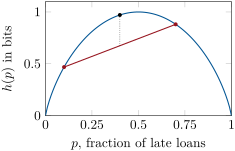
The entropy of two labels, h(p)=−plog⁡2p−(1−p)log⁡2(1−p)h(p) = -p \log_2 p - (1 - p) \log_2(1 - p). A set with 40 %40~\% late loans split into halves with 10 %10~\% and 70 %70~\%: the average entropy of the parts, on the chord, lies below the entropy of the whole, on the curve. The dotted gap is the gain.
在原文中阅读 →