সব বই

পেশাদার

1 Markets I: The Ecosystem and Exchange-Traded Marketsবাজার অনলাইন 2 Markets II: Rates, FX and Creditবাজার অনলাইন 3 Markets III: Commodities, Energy and Cryptoবাজার অনলাইন 4 Quantitative Methodsপদ্ধতি অনলাইন 5 Derivatives and Volatilityডেরিভেটিভস অনলাইন 6 Rates, Credit, XVA and Riskসুদহার, ঋণ ও ঝুঁকি অনলাইন 7 Research Craft: Predictors, Backtests, Measurement, Portfoliosগবেষণা অনলাইন 8 Strategies I: Equities and Futuresকৌশল অনলাইন 9 Strategies II: Volatility, Relative Value, Macro and the Bank Desksকৌশল অনলাইন 10 Microstructure and Executionএক্সিকিউশন অনলাইন 11 Market Making and High-Frequency Tradingমার্কেট মেকিং অনলাইন 12 Machine Learning for Marketsমেশিন লার্নিং অনলাইন 13 Low-Latency Softwareপ্রযুক্তি অনলাইন 14 Networks, Hardware and Trading Infrastructureপ্রযুক্তি অনলাইন 15 Research, Data and Risk Platformsপ্রযুক্তি অনলাইন 16 The Desk and the Firmপ্রতিষ্ঠান অনলাইন 17 The Industry: Firms, Roles and Careersক্যারিয়ার অনলাইন 18 Interviews I: Maths, Probability and Speedক্যারিয়ার অনলাইন 19 Interviews II: Markets, Trading Games and the Final Roundক্যারিয়ার অনলাইন 20 Interviews III: Codeক্যারিয়ার অনলাইন
অ্যাপ পরিচিতি Coach সাইন ইন পড়া শুরু করো

বইগুলো এখনো বাংলা ভাষায় পাওয়া যায় না — ইংরেজি সংস্করণ দেখানো হচ্ছে।

Computer Science · পরিভাষা

Merkle–Damgård construction, length-extension attack কী?

অন্য নাম: Merkle--Damgård construction · length-extension attack

Definition 27.9 University Computer Science — Year 3 · অধ্যায় 27 — Symmetric Cryptography and Hash Functions

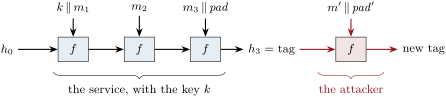
The Merkle–Damgård construction hashes a message by padding it to whole blocks, with its length in the last one, and running a compression function ff along the blocks: h0h_0 is a fixed initial value, hi=f(hi−1,Mi)h_i = f(h_{i-1}, M_i), and the digest is hnh_n. A length-extension attack uses H(m)H(m) and the length of mm, without mm, to compute H(m ∥ pad ∥ m′)H(m \,\|\, \mathit{pad} \,\|\, m') for any m′m', by continuing the chain from hnh_n.

The Merkle–Damgård chain of H(k \,\|\, m), and its continuation. The tag is the whole state after the last block, so anyone who knows it can hash further blocks; the result is the tag of k \,\|\, m \,\|\, pad \,\|\, m'.
The Merkle–Damgård chain of H(k ∥ m)H(k \,\|\, m), and its continuation. The tag is the whole state after the last block, so anyone who knows it can hash further blocks; the result is the tag of k ∥ m ∥ pad ∥ m′k \,\|\, m \,\|\, \mathit{pad} \,\|\, m'.
প্রসঙ্গসহ পড়ো →