全部书籍

专业

应用 关于 Coach 登录 开始阅读

书籍暂未推出简体中文版——当前显示英文版。

Computer Science · 术语表

什么是 Merkle–Damgård construction, length-extension attack?

又称: Merkle--Damgård construction · length-extension attack

Definition 27.9 University Computer Science — Year 3 · 第 27 章 — Symmetric Cryptography and Hash Functions

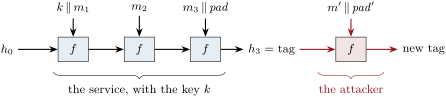
The Merkle–Damgård construction hashes a message by padding it to whole blocks, with its length in the last one, and running a compression function ff along the blocks: h0h_0 is a fixed initial value, hi=f(hi−1,Mi)h_i = f(h_{i-1}, M_i), and the digest is hnh_n. A length-extension attack uses H(m)H(m) and the length of mm, without mm, to compute H(m ∥ pad ∥ m′)H(m \,\|\, \mathit{pad} \,\|\, m') for any m′m', by continuing the chain from hnh_n.

The Merkle–Damgård chain of H(k \,\|\, m), and its continuation. The tag is the whole state after the last block, so anyone who knows it can hash further blocks; the result is the tag of k \,\|\, m \,\|\, pad \,\|\, m'.
The Merkle–Damgård chain of H(k ∥ m)H(k \,\|\, m), and its continuation. The tag is the whole state after the last block, so anyone who knows it can hash further blocks; the result is the tag of k ∥ m ∥ pad ∥ m′k \,\|\, m \,\|\, \mathit{pad} \,\|\, m'.
在原文中阅读 →