
All books

Professional

Apps About Coach Log in Start reading

Earth and Space Sciences · Glossary

What is Direct imaging; coronagraph?

Also known as: direct imaging · coronagraph

Definition 28.9 University Earth and Space Sciences — Year 3 · Chapter 28 — Exoplanets

Direct imaging detects a planet by its own light, reflected or emitted, separated on the sky from the light of its star. A coronagraph is an instrument that blocks the light of the star at the focus of the telescope, by a mask or by the interference of the light, so that faint sources close to the star can be seen.
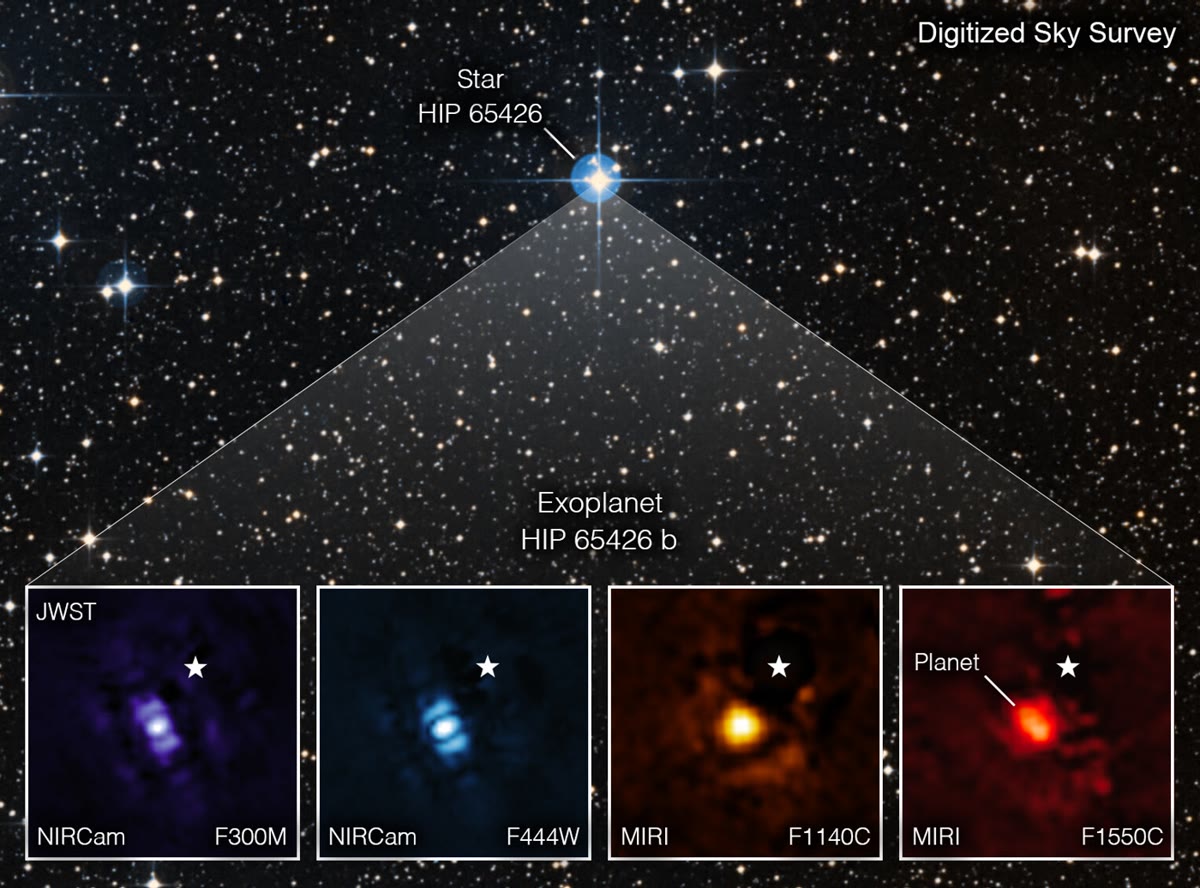
The first exoplanet imaged by the James Webb Space Telescope, HIP 65426 b, in four infrared filters (bottom; top, the star’s field in a ground-based sky survey); the light of the star, at the position of the star symbol, is blocked by the coronagraphs. The planet is a young gas giant of about 6 to 8 Jupiter masses, some 15 to 20 million years old, about a hundred times farther from its star than the Earth is from the Sun. Image NASA/ESA/CSA, A Carter (UCSC), the ERS 1386 team, and A. Pagan (STScI), CC BY 4.0.
Read in context →