All books

Professional

Apps About Coach Log in Start reading

Earth and Space Sciences · Glossary

What is Magnetic anomaly?

Definition 10.5 High School Earth and Space Sciences · Chapter 10 — From Continental Drift to Seafloor Spreading

At a point of the sea surface, the magnetic anomaly is the measured strength of the magnetic field minus the strength expected there from the Earth’s field alone. It is positive where the rocks below add to the field, negative where they oppose it. It is small compared with the field itself, and measured in nanoteslas (nT\mathrm{nT}).

Magnetic anomalies computed across a fast and a slow ridge from the polarity time scale, for floor up to 5 million years old on each side. Under each profile, the strips of floor (black: normal; white: reversed). The anomaly is positive above normal strips and negative above reversed ones; it changes sign at the boundaries. The dashed lines mark the boundary of 3.58 million years. Note the different scales of distance: the slow ridge packs the same history into a sixth of the width, and its shortest events blur together. A model computed with chosen values (a layer magnetised at 5\, A/ m, magnetised vertically, as at high latitudes); time scale from Cande and Kent (1995).
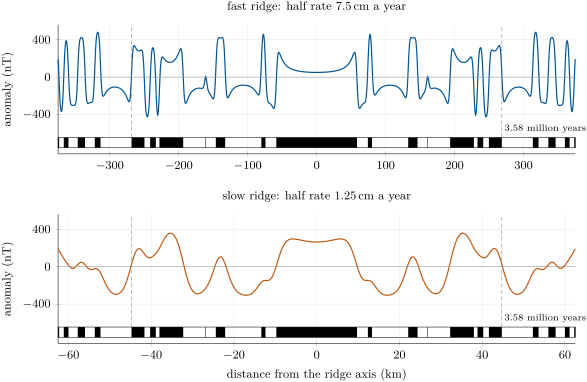
Magnetic anomalies computed across a fast and a slow ridge from the polarity time scale, for floor up to 5 million years old on each side. Under each profile, the strips of floor (black: normal; white: reversed). The anomaly is positive above normal strips and negative above reversed ones; it changes sign at the boundaries. The dashed lines mark the boundary of 3.58 million years. Note the different scales of distance: the slow ridge packs the same history into a sixth of the width, and its shortest events blur together. A model computed with chosen values (a layer magnetised at 5 A/m5\,\mathrm{A}/\mathrm{m}, magnetised vertically, as at high latitudes); time scale from Cande and Kent (1995).
Read in context →