
全部书籍

专业

应用 关于 Coach 登录 开始阅读

书籍暂未推出简体中文版——当前显示英文版。

Earth and Space Sciences · 术语表

什么是 Mass–radius relation?

又称: mass--radius relation

Definition 28.15 University Earth and Space Sciences — Year 3 · 第 28 章 — Exoplanets

The mass–radius relation of a composition is the radius of a planet of that composition as a function of its mass, computed from the equations of state of its materials in hydrostatic equilibrium; a measured planet is compared with the relations of candidate compositions.
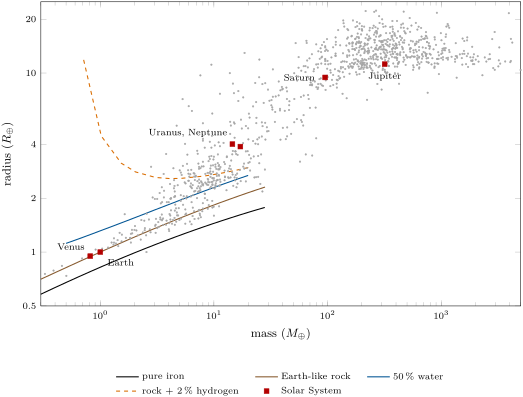
Mass and radius of 1078 transiting planets whose mass is measured to better than 25\,\% and radius to better than 10\,\% (grey; NASA Exoplanet Archive, 23 October 2026), with model curves of L. Zeng and others (2016, 2019): pure iron; Earth-like rock, a third iron and two thirds silicate; half water on such a core, at 500\, K; an Earth-like core with a hydrogen envelope of 2\,\% of its mass, at 500\, K. Red squares: the Solar System’s planets (Mercury and Mars lie off the scale, to the left).
Mass and radius of 1078 transiting planets whose mass is measured to better than 25 %25\,\% and radius to better than 10 %10\,\% (grey; NASA Exoplanet Archive, 23 October 2026), with model curves of L. Zeng and others (2016, 2019): pure iron; Earth-like rock, a third iron and two thirds silicate; half water on such a core, at 500 K500\,\mathrm{K}; an Earth-like core with a hydrogen envelope of 2 %2\,\% of its mass, at 500 K500\,\mathrm{K}. Red squares: the Solar System’s planets (Mercury and Mars lie off the scale, to the left).
在原文中阅读 →