
全部书籍

专业

应用 关于 Coach 登录 开始阅读

书籍暂未推出简体中文版——当前显示英文版。

Earth and Space Sciences · 术语表

什么是 Radial-velocity method; minimum mass?

又称: radial-velocity method · minimum mass

Definition 28.1 University Earth and Space Sciences — Year 3 · 第 28 章 — Exoplanets

The radial-velocity method detects a planet by the periodic variation of the radial velocity of its star, measured from the Doppler shift of the lines of the star’s spectrum. When the inclination ii of the orbit to the plane of the sky is unknown, it measures only the product mpsin⁡im_p\sin i of the planet’s mass by the sine of the inclination, the minimum mass of the planet.
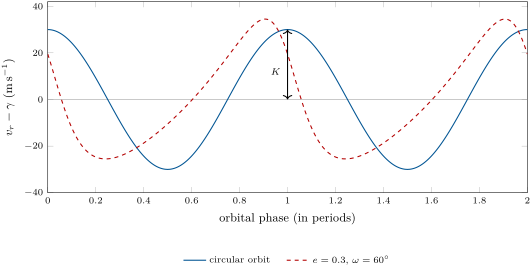
The radial velocity of a star with one planet, over two orbits, for an invented planet with K = 30\, m\, s-1 and a period of ten days. On a circular orbit (solid) the curve is a sinusoid of semi-amplitude K. On an eccentric orbit (dashed) the star moves fastest near periastron, and the curve becomes lopsided: its extremes are K(1 ± e ) and the peak-to-peak swing stays 2K.
The radial velocity of a star with one planet, over two orbits, for an invented planet with K=30 m s−1K = 30\,\mathrm{m}\,\mathrm{s}^{-1} and a period of ten days. On a circular orbit (solid) the curve is a sinusoid of semi-amplitude KK. On an eccentric orbit (dashed) the star moves fastest near periastron, and the curve becomes lopsided: its extremes are K(1±ecos⁡ω)K(1 \pm e\cos\omega) and the peak-to-peak swing stays 2K2K.
在原文中阅读 →