
全部书籍

专业

应用 关于 Coach 登录 开始阅读

书籍暂未推出简体中文版——当前显示英文版。

Earth and Space Sciences · 术语表

什么是 Remanent magnetisation; Curie temperature?

又称: Curie temperature · remanent magnetisation

Definition 10.3 High School Earth and Space Sciences · 第 10 章 — From Continental Drift to Seafloor Spreading

The Curie temperature of a magnetic mineral is the temperature above which it cannot keep a magnetisation of its own: about 580 ∘C580\,{}^{\circ}\mathrm{C} for magnetite. A rock whose magnetic grains cool through their Curie temperature in the Earth’s field keeps a magnetisation parallel to the field of that time, the remanent magnetisation. It lasts long after the field has changed, unless the rock is heated again above the Curie temperature.
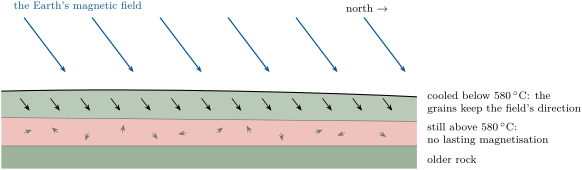
A lava flow cooling (schematic, Northern Hemisphere, where the field points north and down). The top of the flow has cooled below the Curie temperature of magnetite: its magnetic grains (black arrows) keep the direction of the field. The interior, still hotter, records nothing yet; it will record the field of the moment it cools.
在原文中阅读 →