
جميع الكتب

مهني

1 Markets I: The Ecosystem and Exchange-Traded Marketsالأسواق عبر الإنترنت 2 Markets II: Rates, FX and Creditالأسواق عبر الإنترنت 3 Markets III: Commodities, Energy and Cryptoالأسواق عبر الإنترنت 4 Quantitative Methodsالأساليب عبر الإنترنت 5 Derivatives and Volatilityالمشتقات عبر الإنترنت 6 Rates, Credit, XVA and Riskالفائدة والائتمان والمخاطر عبر الإنترنت 7 Research Craft: Predictors, Backtests, Measurement, Portfoliosالبحث عبر الإنترنت 8 Strategies I: Equities and Futuresالاستراتيجيات عبر الإنترنت 9 Strategies II: Volatility, Relative Value, Macro and the Bank Desksالاستراتيجيات عبر الإنترنت 10 Microstructure and Executionالتنفيذ عبر الإنترنت 11 Market Making and High-Frequency Tradingصناعة السوق عبر الإنترنت 12 Machine Learning for Marketsتعلم الآلة عبر الإنترنت 13 Low-Latency Softwareالتكنولوجيا عبر الإنترنت 14 Networks, Hardware and Trading Infrastructureالتكنولوجيا عبر الإنترنت 15 Research, Data and Risk Platformsالتكنولوجيا عبر الإنترنت 16 The Desk and the Firmالشركة عبر الإنترنت 17 The Industry: Firms, Roles and Careersالمسارات المهنية عبر الإنترنت 18 Interviews I: Maths, Probability and Speedالمسارات المهنية عبر الإنترنت 19 Interviews II: Markets, Trading Games and the Final Roundالمسارات المهنية عبر الإنترنت 20 Interviews III: Codeالمسارات المهنية عبر الإنترنت
التطبيقات حول المدرب تسجيل الدخول ابدأ القراءة

Economics · المسرد

ما معنى Adverse selection؟

Definition 20.2 High School Economics · الفصل 20 — Asymmetric Information

Adverse selection occurs when the hidden characteristics of those who choose to trade make the deal worse for the uninformed side: the cars offered for sale are the worse ones, the people who buy insurance are the riskier ones.
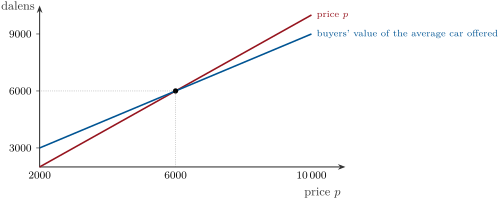
The Brenland market. Above a price of 6000, buyers value the average car offered at less than its price, and they do not buy; the price settles at 6000.

أمثلة

Example 20.3 (Used cars in Brenland)

The qualities of a town’s used cars are spread evenly between 2000 and 10 000 dalens; a seller values his car at its quality qq, a buyer at 1.5q1.5q. Every car is worth more to a buyer than to its seller, so all would be sold if buyers could see quality. They cannot. At a price pp, only the owners of cars with q≤pq \le p sell; the average quality offered is (2000+p)/2(2000 + p)/2, which a buyer values at 1.5×(2000+p)/2=1500+0.75p1.5 \times (2000 + p)/2 = 1500 + 0.75p. Buyers pay pp only if that is at least pp, that is p≤6000p \le 6000. At 6000, the cars between 6000 and 10 000 stay with their owners: half the cars, and the better half, are never sold.

اقرأ في الفصل →
Definition 15.2 University Economics — Year 2 · الفصل 15 — Adverse Selection

Adverse selection occurs when one side of a trade has private information about the quality or risk of what is traded, and at any given price the trades that take place are disproportionately those that are worst for the uninformed side.

اقرأ في الفصل →