
全部书籍

专业

应用 关于 Coach 登录 开始阅读

书籍暂未推出简体中文版——当前显示英文版。

Economics · 术语表

什么是 Adverse selection?

Definition 20.2 High School Economics · 第 20 章 — Asymmetric Information

Adverse selection occurs when the hidden characteristics of those who choose to trade make the deal worse for the uninformed side: the cars offered for sale are the worse ones, the people who buy insurance are the riskier ones.
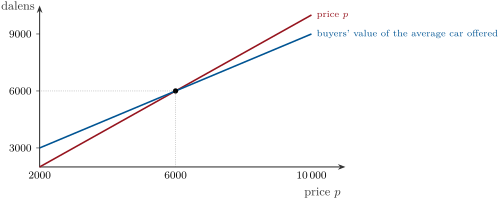
The Brenland market. Above a price of 6000, buyers value the average car offered at less than its price, and they do not buy; the price settles at 6000.

示例

Example 20.3 (Used cars in Brenland)

The qualities of a town’s used cars are spread evenly between 2000 and 10 000 dalens; a seller values his car at its quality qq, a buyer at 1.5q1.5q. Every car is worth more to a buyer than to its seller, so all would be sold if buyers could see quality. They cannot. At a price pp, only the owners of cars with q≤pq \le p sell; the average quality offered is (2000+p)/2(2000 + p)/2, which a buyer values at 1.5×(2000+p)/2=1500+0.75p1.5 \times (2000 + p)/2 = 1500 + 0.75p. Buyers pay pp only if that is at least pp, that is p≤6000p \le 6000. At 6000, the cars between 6000 and 10 000 stay with their owners: half the cars, and the better half, are never sold.

在原文中阅读 →
Definition 15.2 University Economics — Year 2 · 第 15 章 — Adverse Selection

Adverse selection occurs when one side of a trade has private information about the quality or risk of what is traded, and at any given price the trades that take place are disproportionately those that are worst for the uninformed side.

在原文中阅读 →