
Todos os livros

Profissional

Apps Sobre Coach Entrar Começar a ler

Economics · Glossário

O que é Collusion?

Definition 13.12 University Economics — Year 2 · Capítulo 13 — Repeated Games

Collusion is an equilibrium of a repeated game between firms in which prices are held above, or quantities below, those of the equilibrium of the stage game, sustained by the threat that a deviation will be followed by lower profits. It is tacit when it involves no explicit agreement.
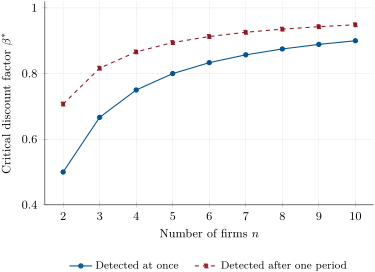
The critical discount factor for collusion among n firms competing on price. When a deviation is detected only after L periods, the deviator keeps the whole market for L + 1 periods, and the condition becomes L + 1 1 - 1/n; the dashed line is L = 1.
The critical discount factor for collusion among nn firms competing on price. When a deviation is detected only after LL periods, the deviator keeps the whole market for L+1L + 1 periods, and the condition becomes βL+1≥1−1/n\beta^{L + 1} \ge 1 - 1/n; the dashed line is L=1L = 1.
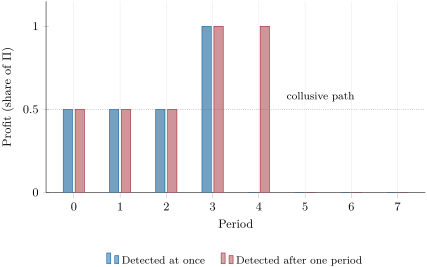
Profit of a firm that deviates in period 3 from collusion in a duopoly competing on price. It earns half the monopoly profit while colluding, the whole of it in the period it undercuts, and nothing once the rival reverts to pricing at cost. A detection lag of one period adds a second period of full profit.
Ler no capítulo →