جميع الكتب

مهني

1 Markets I: The Ecosystem and Exchange-Traded Marketsالأسواق عبر الإنترنت 2 Markets II: Rates, FX and Creditالأسواق عبر الإنترنت 3 Markets III: Commodities, Energy and Cryptoالأسواق عبر الإنترنت 4 Quantitative Methodsالأساليب عبر الإنترنت 5 Derivatives and Volatilityالمشتقات عبر الإنترنت 6 Rates, Credit, XVA and Riskالفائدة والائتمان والمخاطر عبر الإنترنت 7 Research Craft: Predictors, Backtests, Measurement, Portfoliosالبحث عبر الإنترنت 8 Strategies I: Equities and Futuresالاستراتيجيات عبر الإنترنت 9 Strategies II: Volatility, Relative Value, Macro and the Bank Desksالاستراتيجيات عبر الإنترنت 10 Microstructure and Executionالتنفيذ عبر الإنترنت 11 Market Making and High-Frequency Tradingصناعة السوق عبر الإنترنت 12 Machine Learning for Marketsتعلم الآلة عبر الإنترنت 13 Low-Latency Softwareالتكنولوجيا عبر الإنترنت 14 Networks, Hardware and Trading Infrastructureالتكنولوجيا عبر الإنترنت 15 Research, Data and Risk Platformsالتكنولوجيا عبر الإنترنت 16 The Desk and the Firmالشركة عبر الإنترنت 17 The Industry: Firms, Roles and Careersالمسارات المهنية عبر الإنترنت 18 Interviews I: Maths, Probability and Speedالمسارات المهنية عبر الإنترنت 19 Interviews II: Markets, Trading Games and the Final Roundالمسارات المهنية عبر الإنترنت 20 Interviews III: Codeالمسارات المهنية عبر الإنترنت
التطبيقات حول المدرب تسجيل الدخول ابدأ القراءة

Economics · المسرد

ما معنى Deadweight loss؟

Definition 9.6 High School Economics · الفصل 9 — What Prices Do

The deadweight loss of a rule or a tax is the fall in total surplus it causes: the surplus of units that buyers value above their cost but that are no longer traded, or of units traded that cost more than buyers value them.
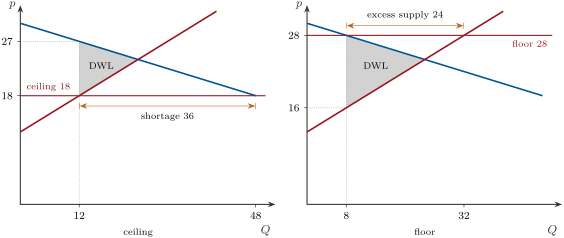

Left: a ceiling of 18 dalens leaves sellers offering 12 units while buyers want 48; the grey triangle (54 dalens) is the deadweight loss. Right: a floor of 28 dalens leaves buyers taking 8 units while sellers offer 32; if only the 8 units bought are produced, the grey triangle (96 dalens) is lost.
اقرأ في الفصل →
Definition 13.6 University Economics — Year 1 · الفصل 13 — Partial Equilibrium and Welfare

The deadweight loss of a tax is the fall in total surplus, revenue included:

DWL(τ)=∫QτQ0(Pd(x)−Ps(x))  ⁣dx,\mathrm{DWL}(\tau) = \int_{Q_\tau}^{Q_0}\bigl(P^d(x) - P^s(x)\bigr)\,\dd x,

the surplus of the units no longer traded. Drawn with straight lines it is a triangle, the Harberger triangle.
Left: Brenland’s sugar market (invented), demand Q = 120 - 10P and supply Q = 10p, with a tax of 1.2 dalens a kilogram: buyers pay 6.6, sellers keep 5.4, revenue is 64.8 and the deadweight loss 3.6 (millions of dalens a year). Right: as the tax rises, revenue (60 - 5 ) peaks at = 6 and then falls, while the loss 2.5 2 keeps rising.
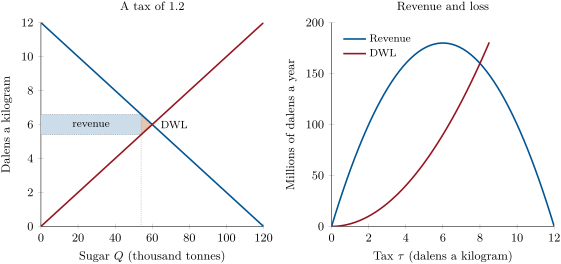
Left: Brenland’s sugar market (invented), demand Q=120−10PQ = 120 - 10P and supply Q=10pQ = 10p, with a tax of 1.2 dalens a kilogram: buyers pay 6.6, sellers keep 5.4, revenue is 64.8 and the deadweight loss 3.6 (millions of dalens a year). Right: as the tax rises, revenue τ(60−5τ)\tau(60 - 5\tau) peaks at τ=6\tau = 6 and then falls, while the loss 2.5τ22.5\tau^2 keeps rising.
اقرأ في الفصل →