सभी किताबें

पेशेवर

1 Markets I: The Ecosystem and Exchange-Traded Marketsबाज़ार ऑनलाइन 2 Markets II: Rates, FX and Creditबाज़ार ऑनलाइन 3 Markets III: Commodities, Energy and Cryptoबाज़ार ऑनलाइन 4 Quantitative Methodsविधियाँ ऑनलाइन 5 Derivatives and Volatilityडेरिवेटिव्स ऑनलाइन 6 Rates, Credit, XVA and Riskब्याज दरें, क्रेडिट और जोखिम ऑनलाइन 7 Research Craft: Predictors, Backtests, Measurement, Portfoliosअनुसंधान ऑनलाइन 8 Strategies I: Equities and Futuresरणनीतियाँ ऑनलाइन 9 Strategies II: Volatility, Relative Value, Macro and the Bank Desksरणनीतियाँ ऑनलाइन 10 Microstructure and Executionनिष्पादन ऑनलाइन 11 Market Making and High-Frequency Tradingमार्केट मेकिंग ऑनलाइन 12 Machine Learning for Marketsमशीन लर्निंग ऑनलाइन 13 Low-Latency Softwareतकनीक ऑनलाइन 14 Networks, Hardware and Trading Infrastructureतकनीक ऑनलाइन 15 Research, Data and Risk Platformsतकनीक ऑनलाइन 16 The Desk and the Firmफ़र्म ऑनलाइन 17 The Industry: Firms, Roles and Careersकरियर ऑनलाइन 18 Interviews I: Maths, Probability and Speedकरियर ऑनलाइन 19 Interviews II: Markets, Trading Games and the Final Roundकरियर ऑनलाइन 20 Interviews III: Codeकरियर ऑनलाइन
ऐप्स परिचय Coach लॉग इन पढ़ना शुरू करें

Economics · शब्दावली

Deadweight loss क्या है?

Definition 9.6 High School Economics · अध्याय 9 — What Prices Do

The deadweight loss of a rule or a tax is the fall in total surplus it causes: the surplus of units that buyers value above their cost but that are no longer traded, or of units traded that cost more than buyers value them.
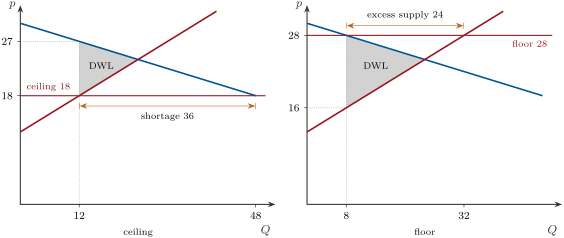

Left: a ceiling of 18 dalens leaves sellers offering 12 units while buyers want 48; the grey triangle (54 dalens) is the deadweight loss. Right: a floor of 28 dalens leaves buyers taking 8 units while sellers offer 32; if only the 8 units bought are produced, the grey triangle (96 dalens) is lost.
अध्याय में पढ़ें →
Definition 13.6 University Economics — Year 1 · अध्याय 13 — Partial Equilibrium and Welfare

The deadweight loss of a tax is the fall in total surplus, revenue included:

DWL(τ)=∫QτQ0(Pd(x)−Ps(x))  ⁣dx,\mathrm{DWL}(\tau) = \int_{Q_\tau}^{Q_0}\bigl(P^d(x) - P^s(x)\bigr)\,\dd x,

the surplus of the units no longer traded. Drawn with straight lines it is a triangle, the Harberger triangle.
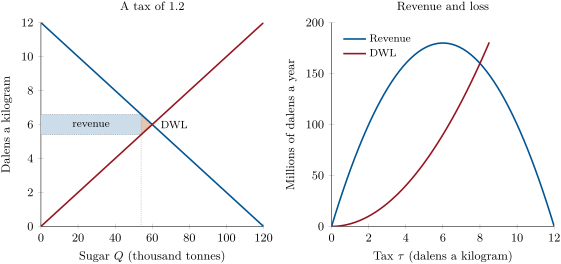
Left: Brenland’s sugar market (invented), demand Q = 120 - 10P and supply Q = 10p, with a tax of 1.2 dalens a kilogram: buyers pay 6.6, sellers keep 5.4, revenue is 64.8 and the deadweight loss 3.6 (millions of dalens a year). Right: as the tax rises, revenue (60 - 5 ) peaks at = 6 and then falls, while the loss 2.5 2 keeps rising.
Left: Brenland’s sugar market (invented), demand Q=120−10PQ = 120 - 10P and supply Q=10pQ = 10p, with a tax of 1.2 dalens a kilogram: buyers pay 6.6, sellers keep 5.4, revenue is 64.8 and the deadweight loss 3.6 (millions of dalens a year). Right: as the tax rises, revenue τ(60−5τ)\tau(60 - 5\tau) peaks at τ=6\tau = 6 and then falls, while the loss 2.5τ22.5\tau^2 keeps rising.
अध्याय में पढ़ें →