
সব বই

পেশাদার

1 Markets I: The Ecosystem and Exchange-Traded Marketsবাজার অনলাইন 2 Markets II: Rates, FX and Creditবাজার অনলাইন 3 Markets III: Commodities, Energy and Cryptoবাজার অনলাইন 4 Quantitative Methodsপদ্ধতি অনলাইন 5 Derivatives and Volatilityডেরিভেটিভস অনলাইন 6 Rates, Credit, XVA and Riskসুদহার, ঋণ ও ঝুঁকি অনলাইন 7 Research Craft: Predictors, Backtests, Measurement, Portfoliosগবেষণা অনলাইন 8 Strategies I: Equities and Futuresকৌশল অনলাইন 9 Strategies II: Volatility, Relative Value, Macro and the Bank Desksকৌশল অনলাইন 10 Microstructure and Executionএক্সিকিউশন অনলাইন 11 Market Making and High-Frequency Tradingমার্কেট মেকিং অনলাইন 12 Machine Learning for Marketsমেশিন লার্নিং অনলাইন 13 Low-Latency Softwareপ্রযুক্তি অনলাইন 14 Networks, Hardware and Trading Infrastructureপ্রযুক্তি অনলাইন 15 Research, Data and Risk Platformsপ্রযুক্তি অনলাইন 16 The Desk and the Firmপ্রতিষ্ঠান অনলাইন 17 The Industry: Firms, Roles and Careersক্যারিয়ার অনলাইন 18 Interviews I: Maths, Probability and Speedক্যারিয়ার অনলাইন 19 Interviews II: Markets, Trading Games and the Final Roundক্যারিয়ার অনলাইন 20 Interviews III: Codeক্যারিয়ার অনলাইন
অ্যাপ পরিচিতি Coach সাইন ইন পড়া শুরু করো

বইগুলো এখনো বাংলা ভাষায় পাওয়া যায় না — ইংরেজি সংস্করণ দেখানো হচ্ছে।

Economics · পরিভাষা

Efficient risk sharing কী?

Definition 2.14 University Economics — Year 2 · অধ্যায় 2 — Insurance and Risk Sharing

An allocation achieves efficient risk sharing if no other allocation of the same aggregate endowment gives one household a higher expected utility without giving the other a lower one.
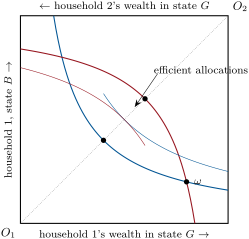
Two households, two equally likely states G and B, no aggregate risk: the total is 100 in both states, so the box is square. Household 1 is rich in G, household 2 in B (endowment ). Indifference curves (blue for household 1, red for household 2, here u =) are tangent only on the diagonal, which is both households’ certainty line: every efficient allocation is full mutual insurance.
Two households, two equally likely states GG and BB, no aggregate risk: the total is 100 in both states, so the box is square. Household 1 is rich in GG, household 2 in BB (endowment ω\omega). Indifference curves (blue for household 1, red for household 2, here u=ln⁡u = \ln) are tangent only on the diagonal, which is both households’ certainty line: every efficient allocation is full mutual insurance.

উদাহরণ

Example 2.17 (Two CARA households)

With ui(z)=−e−aiz/aiu_i(z) = -e^{-a_i z}/a_i, ui′(z)=e−aizu_i'(z) = e^{-a_i z} and the rule says a2z2(s)−a1z1(s)a_2 z_2(s) - a_1 z_1(s) is the same in every state. With z2=Ω−z1z_2 = \Omega - z_1,

z1(s)=a2a1+a2 Ω(s)+k,z_1(s) = \frac{a_2}{a_1 + a_2}\,\Omega(s) + k,

for a constant kk that sets how the expected total is divided. Each household bears a fixed share of the aggregate risk, its risk tolerance 1/ai1/a_i divided by the total risk tolerance: the less risk-averse household bears more.

প্রসঙ্গসহ পড়ো →