
सभी किताबें

पेशेवर

1 Markets I: The Ecosystem and Exchange-Traded Marketsबाज़ार ऑनलाइन 2 Markets II: Rates, FX and Creditबाज़ार ऑनलाइन 3 Markets III: Commodities, Energy and Cryptoबाज़ार ऑनलाइन 4 Quantitative Methodsविधियाँ ऑनलाइन 5 Derivatives and Volatilityडेरिवेटिव्स ऑनलाइन 6 Rates, Credit, XVA and Riskब्याज दरें, क्रेडिट और जोखिम ऑनलाइन 7 Research Craft: Predictors, Backtests, Measurement, Portfoliosअनुसंधान ऑनलाइन 8 Strategies I: Equities and Futuresरणनीतियाँ ऑनलाइन 9 Strategies II: Volatility, Relative Value, Macro and the Bank Desksरणनीतियाँ ऑनलाइन 10 Microstructure and Executionनिष्पादन ऑनलाइन 11 Market Making and High-Frequency Tradingमार्केट मेकिंग ऑनलाइन 12 Machine Learning for Marketsमशीन लर्निंग ऑनलाइन 13 Low-Latency Softwareतकनीक ऑनलाइन 14 Networks, Hardware and Trading Infrastructureतकनीक ऑनलाइन 15 Research, Data and Risk Platformsतकनीक ऑनलाइन 16 The Desk and the Firmफ़र्म ऑनलाइन 17 The Industry: Firms, Roles and Careersकरियर ऑनलाइन 18 Interviews I: Maths, Probability and Speedकरियर ऑनलाइन 19 Interviews II: Markets, Trading Games and the Final Roundकरियर ऑनलाइन 20 Interviews III: Codeकरियर ऑनलाइन
ऐप्स परिचय Coach लॉग इन पढ़ना शुरू करें

Economics · शब्दावली

Efficient risk sharing क्या है?

Definition 2.14 University Economics — Year 2 · अध्याय 2 — Insurance and Risk Sharing

An allocation achieves efficient risk sharing if no other allocation of the same aggregate endowment gives one household a higher expected utility without giving the other a lower one.
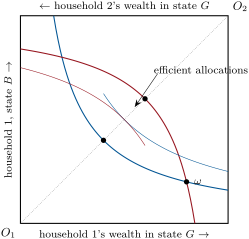
Two households, two equally likely states G and B, no aggregate risk: the total is 100 in both states, so the box is square. Household 1 is rich in G, household 2 in B (endowment ). Indifference curves (blue for household 1, red for household 2, here u =) are tangent only on the diagonal, which is both households’ certainty line: every efficient allocation is full mutual insurance.
Two households, two equally likely states GG and BB, no aggregate risk: the total is 100 in both states, so the box is square. Household 1 is rich in GG, household 2 in BB (endowment ω\omega). Indifference curves (blue for household 1, red for household 2, here u=ln⁡u = \ln) are tangent only on the diagonal, which is both households’ certainty line: every efficient allocation is full mutual insurance.

उदाहरण

Example 2.17 (Two CARA households)

With ui(z)=−e−aiz/aiu_i(z) = -e^{-a_i z}/a_i, ui′(z)=e−aizu_i'(z) = e^{-a_i z} and the rule says a2z2(s)−a1z1(s)a_2 z_2(s) - a_1 z_1(s) is the same in every state. With z2=Ω−z1z_2 = \Omega - z_1,

z1(s)=a2a1+a2 Ω(s)+k,z_1(s) = \frac{a_2}{a_1 + a_2}\,\Omega(s) + k,

for a constant kk that sets how the expected total is divided. Each household bears a fixed share of the aggregate risk, its risk tolerance 1/ai1/a_i divided by the total risk tolerance: the less risk-averse household bears more.

अध्याय में पढ़ें →