جميع الكتب

مهني

1 Markets I: The Ecosystem and Exchange-Traded Marketsالأسواق عبر الإنترنت 2 Markets II: Rates, FX and Creditالأسواق عبر الإنترنت 3 Markets III: Commodities, Energy and Cryptoالأسواق عبر الإنترنت 4 Quantitative Methodsالأساليب عبر الإنترنت 5 Derivatives and Volatilityالمشتقات عبر الإنترنت 6 Rates, Credit, XVA and Riskالفائدة والائتمان والمخاطر عبر الإنترنت 7 Research Craft: Predictors, Backtests, Measurement, Portfoliosالبحث عبر الإنترنت 8 Strategies I: Equities and Futuresالاستراتيجيات عبر الإنترنت 9 Strategies II: Volatility, Relative Value, Macro and the Bank Desksالاستراتيجيات عبر الإنترنت 10 Microstructure and Executionالتنفيذ عبر الإنترنت 11 Market Making and High-Frequency Tradingصناعة السوق عبر الإنترنت 12 Machine Learning for Marketsتعلم الآلة عبر الإنترنت 13 Low-Latency Softwareالتكنولوجيا عبر الإنترنت 14 Networks, Hardware and Trading Infrastructureالتكنولوجيا عبر الإنترنت 15 Research, Data and Risk Platformsالتكنولوجيا عبر الإنترنت 16 The Desk and the Firmالشركة عبر الإنترنت 17 The Industry: Firms, Roles and Careersالمسارات المهنية عبر الإنترنت 18 Interviews I: Maths, Probability and Speedالمسارات المهنية عبر الإنترنت 19 Interviews II: Markets, Trading Games and the Final Roundالمسارات المهنية عبر الإنترنت 20 Interviews III: Codeالمسارات المهنية عبر الإنترنت
التطبيقات حول المدرب تسجيل الدخول ابدأ القراءة

Economics · المسرد

ما معنى Elasticity of intertemporal substitution؟

Definition 3.8 University Economics — Year 2 · الفصل 3 — Intertemporal Choice

The elasticity of intertemporal substitution (EIS) is the percentage change in the ratio ct+1/ctc_{t+1}/c_t caused by a one per cent rise in the gross interest rate 1+r1 + r, along the Euler equation. By Corollary 3.7 it equals 1/γ1/\gamma under CRRA utility.

Two periods, u =, = 0.95, r = 5 per cent. A student earns 20 now and 60 next year (thousands of dalens; point E). Lifetime resources are 20 + 60/1.05 = 77.1. The best plan A is where an indifference curve touches the budget line: there the slope of the curve, -u'(c_0)/( u'(c_1)), equals -(1 + r), which is the Euler equation. Since (1 + r) = 0.9975, the plan is almost flat; the student borrows 19.6 now.
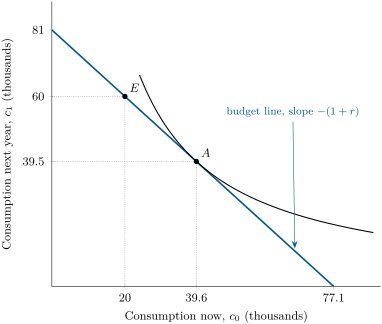
Two periods, u=ln⁡u = \ln, β=0.95\beta = 0.95, r=5r = 5 per cent. A student earns 20 now and 60 next year (thousands of dalens; point EE). Lifetime resources are 20+60/1.05=77.120 + 60/1.05 = 77.1. The best plan AA is where an indifference curve touches the budget line: there the slope of the curve, −u′(c0)/(βu′(c1))-u'(c_0)/(\beta u'(c_1)), equals −(1+r)-(1 + r), which is the Euler equation. Since β(1+r)=0.9975\beta(1 + r) = 0.9975, the plan is almost flat; the student borrows 19.6 now.
اقرأ في الفصل →