Alle boeken

Professioneel

Apps Over Coach Inloggen Begin met lezen

Economics · Begrippenlijst

Wat is Elasticity of intertemporal substitution?

Definition 3.8 University Economics — Year 2 · Hoofdstuk 3 — Intertemporal Choice

The elasticity of intertemporal substitution (EIS) is the percentage change in the ratio ct+1/ctc_{t+1}/c_t caused by a one per cent rise in the gross interest rate 1+r1 + r, along the Euler equation. By Corollary 3.7 it equals 1/γ1/\gamma under CRRA utility.

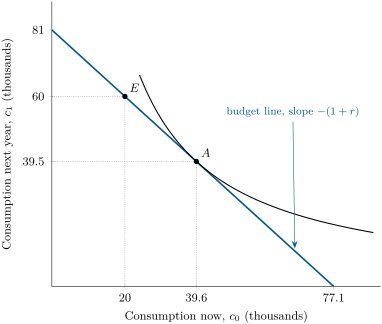
Two periods, u =, = 0.95, r = 5 per cent. A student earns 20 now and 60 next year (thousands of dalens; point E). Lifetime resources are 20 + 60/1.05 = 77.1. The best plan A is where an indifference curve touches the budget line: there the slope of the curve, -u'(c_0)/( u'(c_1)), equals -(1 + r), which is the Euler equation. Since (1 + r) = 0.9975, the plan is almost flat; the student borrows 19.6 now.
Two periods, u=ln⁡u = \ln, β=0.95\beta = 0.95, r=5r = 5 per cent. A student earns 20 now and 60 next year (thousands of dalens; point EE). Lifetime resources are 20+60/1.05=77.120 + 60/1.05 = 77.1. The best plan AA is where an indifference curve touches the budget line: there the slope of the curve, −u′(c0)/(βu′(c1))-u'(c_0)/(\beta u'(c_1)), equals −(1+r)-(1 + r), which is the Euler equation. Since β(1+r)=0.9975\beta(1 + r) = 0.9975, the plan is almost flat; the student borrows 19.6 now.
Lees in het hoofdstuk →