Todos los libros

Profesional

Apps Acerca de Coach Iniciar sesión Empezar a leer

Economics · Glosario

¿Qué es Gini coefficient?

Definition 23.2 High School Economics · Capítulo 23 — Inequality

The Gini coefficient is the area between the diagonal and the Lorenz curve, divided by the whole area under the diagonal: G=1−2BG = 1 - 2B, where BB is the area under the Lorenz curve.

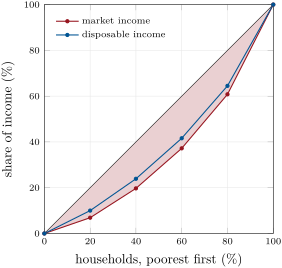
Lorenz curves of Brenland’s household survey (invented), income divided by the square root of household size, by fifths. The shaded area between the diagonal and the market-income curve, divided by 1/2, is its Gini coefficient, 0.30; for disposable income it is 0.24.
Lorenz curves of Brenland’s household survey (invented), income divided by the square root of household size, by fifths. The shaded area between the diagonal and the market-income curve, divided by 12\tfrac12, is its Gini coefficient, 0.30; for disposable income it is 0.24.
Leer en el capítulo →