Tous les livres

Professionnel

Applis À propos Coach Connexion Commencer la lecture

Economics · Glossaire

Qu'est-ce que « Gini coefficient » ?

Definition 23.2 High School Economics · Chapitre 23 — Inequality

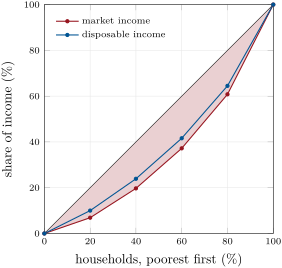
The Gini coefficient is the area between the diagonal and the Lorenz curve, divided by the whole area under the diagonal: G=1−2BG = 1 - 2B, where BB is the area under the Lorenz curve.

Lorenz curves of Brenland’s household survey (invented), income divided by the square root of household size, by fifths. The shaded area between the diagonal and the market-income curve, divided by 1/2, is its Gini coefficient, 0.30; for disposable income it is 0.24.
Lorenz curves of Brenland’s household survey (invented), income divided by the square root of household size, by fifths. The shaded area between the diagonal and the market-income curve, divided by 12\tfrac12, is its Gini coefficient, 0.30; for disposable income it is 0.24.
Lire dans le chapitre →