
Tous les livres

Professionnel

Applis À propos Coach Connexion Commencer la lecture

Economics · Glossaire

Qu'est-ce que « Learning curve » ?

Definition 14.11 High School Economics · Chapitre 14 — Production and Costs

A learning curve relates the cost, or the labour hours, of producing one unit to the cumulative number of units produced so far. It is often summed up by the fall in cost for each doubling of cumulative output: an 80 % curve cuts the cost by 20 % each time cumulative output doubles.

Lire dans le chapitre →
Definition 10.11 University Economics — Year 1 · Chapitre 10 — Cost Minimisation

A learning curve relates unit cost to cumulative output XX, the total produced so far: c(X)=c0X−bc(X) = c_0X^{-b} with b>0b > 0. Each doubling of cumulative output multiplies unit cost by 2−b2^{-b}; the learning rate is 1−2−b1 - 2^{-b}, the percentage fall in cost per doubling.
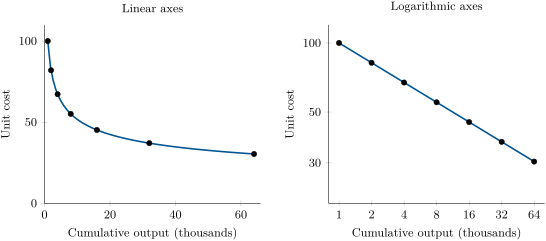
A learning curve with a learning rate of 18\% (b = 0.2863): unit cost falls by 18\% at each doubling of cumulative output, a curve on linear axes and a straight line on logarithmic ones. The points are the weekend problem’s battery plant.
A learning curve with a learning rate of 18%18\% (b=0.2863b = 0.2863): unit cost falls by 18%18\% at each doubling of cumulative output, a curve on linear axes and a straight line on logarithmic ones. The points are the weekend problem’s battery plant.
Lire dans le chapitre →