সব বই

পেশাদার

1 Markets I: The Ecosystem and Exchange-Traded Marketsবাজার অনলাইন 2 Markets II: Rates, FX and Creditবাজার অনলাইন 3 Markets III: Commodities, Energy and Cryptoবাজার অনলাইন 4 Quantitative Methodsপদ্ধতি অনলাইন 5 Derivatives and Volatilityডেরিভেটিভস অনলাইন 6 Rates, Credit, XVA and Riskসুদহার, ঋণ ও ঝুঁকি অনলাইন 7 Research Craft: Predictors, Backtests, Measurement, Portfoliosগবেষণা অনলাইন 8 Strategies I: Equities and Futuresকৌশল অনলাইন 9 Strategies II: Volatility, Relative Value, Macro and the Bank Desksকৌশল অনলাইন 10 Microstructure and Executionএক্সিকিউশন অনলাইন 11 Market Making and High-Frequency Tradingমার্কেট মেকিং অনলাইন 12 Machine Learning for Marketsমেশিন লার্নিং অনলাইন 13 Low-Latency Softwareপ্রযুক্তি অনলাইন 14 Networks, Hardware and Trading Infrastructureপ্রযুক্তি অনলাইন 15 Research, Data and Risk Platformsপ্রযুক্তি অনলাইন 16 The Desk and the Firmপ্রতিষ্ঠান অনলাইন 17 The Industry: Firms, Roles and Careersক্যারিয়ার অনলাইন 18 Interviews I: Maths, Probability and Speedক্যারিয়ার অনলাইন 19 Interviews II: Markets, Trading Games and the Final Roundক্যারিয়ার অনলাইন 20 Interviews III: Codeক্যারিয়ার অনলাইন
অ্যাপ পরিচিতি Coach সাইন ইন পড়া শুরু করো

বইগুলো এখনো বাংলা ভাষায় পাওয়া যায় না — ইংরেজি সংস্করণ দেখানো হচ্ছে।

Economics · পরিভাষা

Marginal product কী?

Definition 14.3 High School Economics · অধ্যায় 14 — Production and Costs

The marginal product of an input is the extra output from one more unit of it, the other inputs being held fixed: f(L+1)−f(L)f(L + 1) - f(L), or f′(L)f'(L) when ff is differentiable.

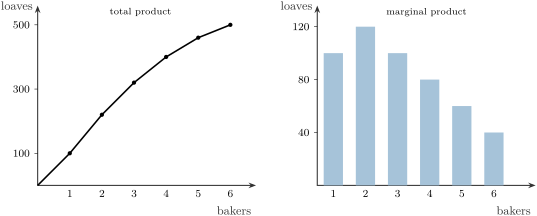
Left: the bakery’s output with one oven and 0 to 6 bakers. Right: the marginal product of each baker. It rises for the second baker, then falls: the total product curve gets flatter.

উদাহরণ

Example 14.4 (Bakers and one oven)

With 0 to 6 bakers, the bakery makes 0, 100, 220, 320, 400, 460 and 500 loaves a day. The marginal products are 100, 120, 100, 80, 60 and 40 loaves. The second baker adds more than the first, because two people can split the kneading and the baking; from the third on, each adds less, because they share one oven and one counter.

প্রসঙ্গসহ পড়ো →
Definition 9.3 University Economics — Year 1 · অধ্যায় 9 — Technology

The marginal product of an input is the partial derivative of the production function with respect to it, fL=∂f/∂Lf_L = \partial f/\partial L and fK=∂f/∂Kf_K = \partial f/\partial K: the extra output from one more unit of the input, the other held fixed. It is diminishing if it falls as the input rises, fLL<0f_{LL} < 0.

প্রসঙ্গসহ পড়ো →