Todos los libros

Profesional

Apps Acerca de Coach Iniciar sesión Empezar a leer

Economics · Glosario

¿Qué es Marginal product?

Definition 14.3 High School Economics · Capítulo 14 — Production and Costs

The marginal product of an input is the extra output from one more unit of it, the other inputs being held fixed: f(L+1)−f(L)f(L + 1) - f(L), or f′(L)f'(L) when ff is differentiable.

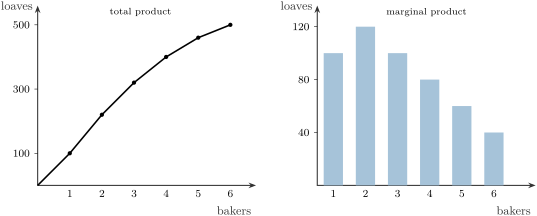
Left: the bakery’s output with one oven and 0 to 6 bakers. Right: the marginal product of each baker. It rises for the second baker, then falls: the total product curve gets flatter.

Ejemplos

Example 14.4 (Bakers and one oven)

With 0 to 6 bakers, the bakery makes 0, 100, 220, 320, 400, 460 and 500 loaves a day. The marginal products are 100, 120, 100, 80, 60 and 40 loaves. The second baker adds more than the first, because two people can split the kneading and the baking; from the third on, each adds less, because they share one oven and one counter.

Leer en el capítulo →
Definition 9.3 University Economics — Year 1 · Capítulo 9 — Technology

The marginal product of an input is the partial derivative of the production function with respect to it, fL=∂f/∂Lf_L = \partial f/\partial L and fK=∂f/∂Kf_K = \partial f/\partial K: the extra output from one more unit of the input, the other held fixed. It is diminishing if it falls as the input rises, fLL<0f_{LL} < 0.

Leer en el capítulo →