সব বই

পেশাদার

1 Markets I: The Ecosystem and Exchange-Traded Marketsবাজার অনলাইন 2 Markets II: Rates, FX and Creditবাজার অনলাইন 3 Markets III: Commodities, Energy and Cryptoবাজার অনলাইন 4 Quantitative Methodsপদ্ধতি অনলাইন 5 Derivatives and Volatilityডেরিভেটিভস অনলাইন 6 Rates, Credit, XVA and Riskসুদহার, ঋণ ও ঝুঁকি অনলাইন 7 Research Craft: Predictors, Backtests, Measurement, Portfoliosগবেষণা অনলাইন 8 Strategies I: Equities and Futuresকৌশল অনলাইন 9 Strategies II: Volatility, Relative Value, Macro and the Bank Desksকৌশল অনলাইন 10 Microstructure and Executionএক্সিকিউশন অনলাইন 11 Market Making and High-Frequency Tradingমার্কেট মেকিং অনলাইন 12 Machine Learning for Marketsমেশিন লার্নিং অনলাইন 13 Low-Latency Softwareপ্রযুক্তি অনলাইন 14 Networks, Hardware and Trading Infrastructureপ্রযুক্তি অনলাইন 15 Research, Data and Risk Platformsপ্রযুক্তি অনলাইন 16 The Desk and the Firmপ্রতিষ্ঠান অনলাইন 17 The Industry: Firms, Roles and Careersক্যারিয়ার অনলাইন 18 Interviews I: Maths, Probability and Speedক্যারিয়ার অনলাইন 19 Interviews II: Markets, Trading Games and the Final Roundক্যারিয়ার অনলাইন 20 Interviews III: Codeক্যারিয়ার অনলাইন
অ্যাপ পরিচিতি Coach সাইন ইন পড়া শুরু করো

বইগুলো এখনো বাংলা ভাষায় পাওয়া যায় না — ইংরেজি সংস্করণ দেখানো হচ্ছে।

Economics · পরিভাষা

Minimum efficient scale কী?

Definition 14.10 High School Economics · অধ্যায় 14 — Production and Costs

The minimum efficient scale is the smallest output at which long-run average cost reaches its lowest value.
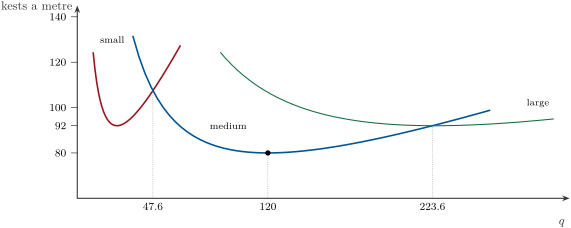

Short-run average total cost of three plant sizes, in kests a metre (the axis starts at 60), against output in thousands of metres a year: the mill of the weekend problem. The long-run average cost is the lowest curve at each output: the small plant up to 47.6, the medium plant up to 223.6, the large one beyond. With only three plant sizes the long-run curve is scalloped: along each plant it falls to that plant’s lowest point and may rise again (the small plant’s cost rises from 92 at 25 to 107.5 at 47.6), and it jumps down where the next plant takes over. Overall it falls to 80 kests at 120 (economies of scale) and rises after (diseconomies), with a small dip to 92 at 225 along the large plant. The minimum efficient scale is 120.
প্রসঙ্গসহ পড়ো →
Definition 10.10 University Economics — Year 1 · অধ্যায় 10 — Cost Minimisation

The minimum efficient scale is the smallest output at which long-run average cost reaches its minimum.
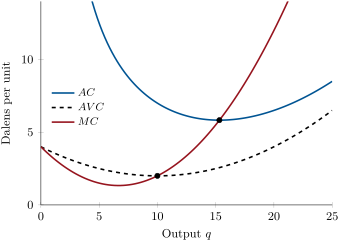
C(q) = 50 + 4q - 0.4q2 + 0.02q3. Marginal cost crosses average variable cost at its minimum, (10, 2), and average cost at its minimum, about (15.3, 5.83).
C(q)=50+4q−0.4q2+0.02q3C(q) = 50 + 4q - 0.4q^2 + 0.02q^3. Marginal cost crosses average variable cost at its minimum, (10,2)(10, 2), and average cost at its minimum, about (15.3,5.83)(15.3, 5.83).
প্রসঙ্গসহ পড়ো →