全部书籍

专业

应用 关于 Coach 登录 开始阅读

书籍暂未推出简体中文版——当前显示英文版。

Economics · 术语表

什么是 Minimum efficient scale?

Definition 14.10 High School Economics · 第 14 章 — Production and Costs

The minimum efficient scale is the smallest output at which long-run average cost reaches its lowest value.
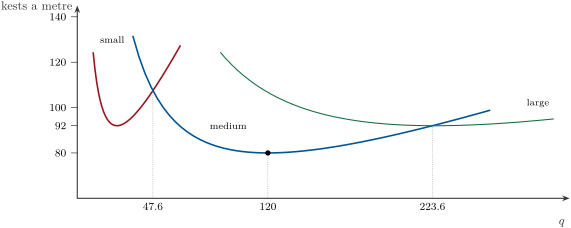

Short-run average total cost of three plant sizes, in kests a metre (the axis starts at 60), against output in thousands of metres a year: the mill of the weekend problem. The long-run average cost is the lowest curve at each output: the small plant up to 47.6, the medium plant up to 223.6, the large one beyond. With only three plant sizes the long-run curve is scalloped: along each plant it falls to that plant’s lowest point and may rise again (the small plant’s cost rises from 92 at 25 to 107.5 at 47.6), and it jumps down where the next plant takes over. Overall it falls to 80 kests at 120 (economies of scale) and rises after (diseconomies), with a small dip to 92 at 225 along the large plant. The minimum efficient scale is 120.
在原文中阅读 →
Definition 10.10 University Economics — Year 1 · 第 10 章 — Cost Minimisation

The minimum efficient scale is the smallest output at which long-run average cost reaches its minimum.
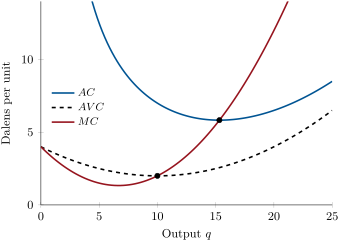
C(q) = 50 + 4q - 0.4q2 + 0.02q3. Marginal cost crosses average variable cost at its minimum, (10, 2), and average cost at its minimum, about (15.3, 5.83).
C(q)=50+4q−0.4q2+0.02q3C(q) = 50 + 4q - 0.4q^2 + 0.02q^3. Marginal cost crosses average variable cost at its minimum, (10,2)(10, 2), and average cost at its minimum, about (15.3,5.83)(15.3, 5.83).
在原文中阅读 →