Tous les livres

Professionnel

Applis À propos Coach Connexion Commencer la lecture

Economics · Glossaire

Qu'est-ce que « Old-age dependency ratio » ?

Definition 4.4 Middle School Economics · Chapitre 4 — Longer Lives, Smaller Families

The old-age dependency ratio of a population is the number of people aged 65 and over for every 100 people aged 15 to 64.
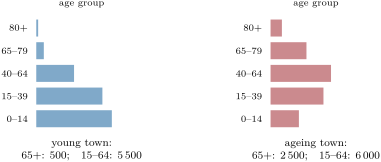

Two invented towns of 10 000 people, by age group: each bar is the number of people in the group. The young town has 9 people aged 65 and over for every 100 of working age (500 5\,500 × 100 9); the ageing town has 42 (2\,500 6\,000 × 100 42).
Two invented towns of 10 000 people, by age group: each bar is the number of people in the group. The young town has 9 people aged 65 and over for every 100 of working age (500÷5 500×100≈9500 \div 5\,500 \times 100 \approx 9); the ageing town has 42 (2 500÷6 000×100≈422\,500 \div 6\,000 \times 100 \approx 42).
Lire dans le chapitre →
Definition 22.7 University Economics — Year 2 · Chapitre 22 — Overlapping Generations

The old-age dependency ratio is the number of people above a retirement age, usually 65, per person of working age, usually 15 to 64.

Lire dans le chapitre →