全部书籍

专业

应用 关于 Coach 登录 开始阅读

书籍暂未推出简体中文版——当前显示英文版。

Economics · 术语表

什么是 Old-age dependency ratio?

Definition 4.4 Middle School Economics · 第 4 章 — Longer Lives, Smaller Families

The old-age dependency ratio of a population is the number of people aged 65 and over for every 100 people aged 15 to 64.
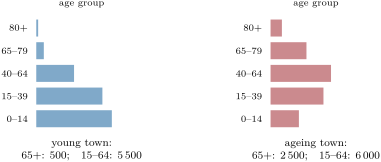

Two invented towns of 10 000 people, by age group: each bar is the number of people in the group. The young town has 9 people aged 65 and over for every 100 of working age (500 5\,500 × 100 9); the ageing town has 42 (2\,500 6\,000 × 100 42).
Two invented towns of 10 000 people, by age group: each bar is the number of people in the group. The young town has 9 people aged 65 and over for every 100 of working age (500÷5 500×100≈9500 \div 5\,500 \times 100 \approx 9); the ageing town has 42 (2 500÷6 000×100≈422\,500 \div 6\,000 \times 100 \approx 42).
在原文中阅读 →
Definition 22.7 University Economics — Year 2 · 第 22 章 — Overlapping Generations

The old-age dependency ratio is the number of people above a retirement age, usually 65, per person of working age, usually 15 to 64.

在原文中阅读 →