
Tous les livres

Professionnel

Applis À propos Coach Connexion Commencer la lecture

Economics · Glossaire

Qu'est-ce que « Private, external and social cost » ?

Aussi appelé : private cost · external cost · social cost · social benefit

Definition 18.2 High School Economics · Chapitre 18 — Externalities

The private cost of a good is the cost borne by its producer. The external cost

is the cost it imposes on others. The social cost

is their sum. In the same way, the social benefit

of a good is the benefit to its buyers plus the benefit to others.
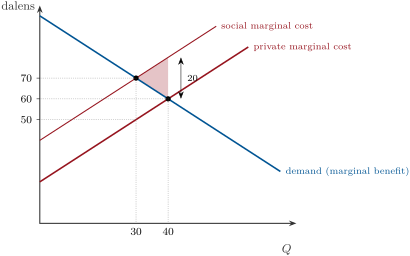
The market sells 40 units, where demand meets private marginal cost; the efficient quantity is 30, where it meets social marginal cost. The shaded triangle, 100 dalens, is the deadweight loss. A tax of 20 a unit, the marginal damage, makes buyers pay 70 and sellers receive 50, and the market sells 30.

Exemples

Example 18.3 (A polluting market)

Demand for a good is p=100−Qp = 100 - Q, its private marginal cost is 20+Q20 + Q, and each unit causes damage of 20 dalens to people nearby. The market settles where demand meets private marginal cost: Q=40Q = 40, p=60p = 60. The social marginal cost is 40+Q40 + Q, and it equals the buyers’ marginal benefit at Q=30Q = 30. The ten units between 30 and 40 cost society more than they are worth to buyers; the lost surplus is 12×(40−30)×20=100\tfrac12 \times (40 - 30) \times 20 = 100 dalens.

Lire dans le chapitre →