এই বইটি এখনো বাংলা ভাষায় পাওয়া যায় না। সংস্করণ: English।
High School Economics · শ্রেণি 10–12
18Externalities
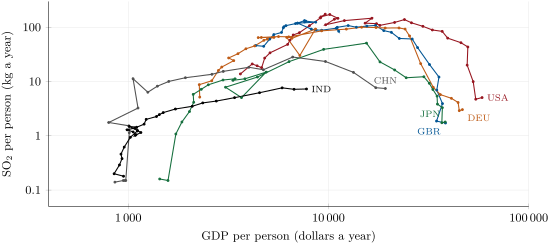
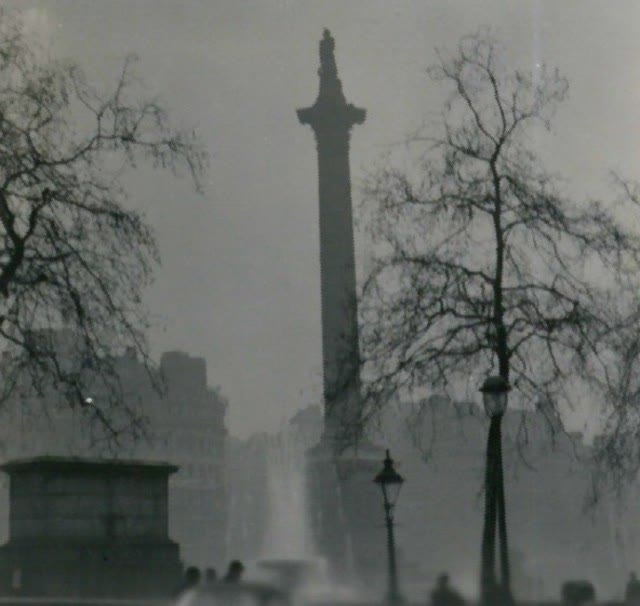
In 1918 the United States emitted about 191 kilograms of sulphur dioxide for each of its inhabitants, mostly from burning coal. Britain had peaked a decade earlier, at 134 kilograms. By 2022 the American figure was 5.1 kilograms and the British 1.7, while incomes per person had grown several times over. China’s emissions per person peaked in 2006 at 29 kilograms and fell to 7.5 by 2022. Sulphur dioxide makes acid rain and fills lungs with fine particles; it harms people who neither produced nor bought the electricity whose making released it.
Such harm is a cost that no price records. This chapter shows why a market then produces too much of the harmful good, and compares the ways of correcting it: bargaining, taxes, tradable permits and rules, each with its evidence. The fall in the chart came with laws, and with changes in fuels and technology; the second chart of the chapter shows one of those laws at work, and what it can and cannot tell.
You already know
From the grades 6–9 volume: sulphur dioxide, released when coal and oil are burned, rose as countries industrialised and later fell in the richest ones. From Chapter 8: total surplus, and why the market quantity maximises it when prices carry all costs and benefits. From Chapter 10: a tax per unit and its incidence. The physics and chemistry of acid rain and of the climate are left to the Earth and space sciences volumes; this chapter takes the damage as given.
18.1 Private cost and social cost
Definition 18.1 (Externality)
An externality is an effect of a person’s or firm’s activity on others that is not paid for through a price. It is a negative externality
when it harms them, a positive externality
when it benefits them.
Definition 18.2 (Private, external and social cost)
The private cost of a good is the cost borne by its producer. The external cost
is the cost it imposes on others. The social cost
is their sum. In the same way, the social benefit
of a good is the benefit to its buyers plus the benefit to others.
Example 18.3 (A polluting market)
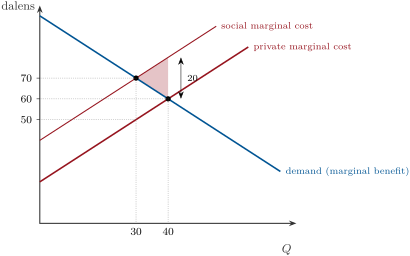
Demand for a good is , its private marginal cost is , and each unit causes damage of 20 dalens to people nearby. The market settles where demand meets private marginal cost: , . The social marginal cost is , and it equals the buyers’ marginal benefit at . The ten units between 30 and 40 cost society more than they are worth to buyers; the lost surplus is dalens.
18.2 Bargaining
The damage is a conflict over the use of something, the air or a river, whose owner is not clear. If the right were clearly given to one side, the two could bargain.
Definition 18.4 (Transaction cost)
A transaction cost is the cost of making a deal: finding the other parties, learning the facts, negotiating, writing the agreement and enforcing it.
Proposition 18.5 (The Coase result)
Suppose a polluter gains and a victim loses from an activity , the right to decide is clearly held by one of them, and they can make any agreement at no transaction cost, paying each other money. Then they agree on the that maximises , whichever of them holds the right. The right decides only who pays whom.
Proof. Any that does not maximise leaves a gain unclaimed: moving to the maximising raises , and a payment from the side that gains to the side that loses can share that rise so that both are better off. So a deal stops only at . If the victim holds the right, the polluter pays to be allowed ; if the polluter holds it, the victim pays it to cut back to . Either way . ∎
Model — The Coase result
Assumes. Rights are clear, the parties are few and know the costs and benefits, and bargaining is cheap.
Predicts. An efficient outcome whoever holds the right; the right decides who pays.
Tested. In twenty nuisance cases followed after a court had ruled, none of the parties tried to bargain, although the ruling made the rights clear: they were angry with each other (Farnsworth 1999). In negotiations between Danish waterworks and the farmers around their wells, farmers used what only they knew to ask for more than their losses, and some talks broke off (Abildtrup, Jensen and Dubgaard 2012).
Breaks. When the parties are many (everyone who breathes a city’s air), when costs are private information, and when bargaining itself is costly or resented.
18.3 Taxes, permits and rules
Definition 18.6 (Pigouvian tax)
A Pigouvian tax is a tax on each unit of a harmful activity equal to its marginal external cost at the efficient quantity.
The tax puts the damage into the producer’s own cost. In the example, a tax of 20 a unit shifts private marginal cost onto social marginal cost, and the market itself sells the efficient 30 units. The government collects dalens, which it can spend or return.
Model — The Pigouvian tax
Assumes. The marginal external cost is known and the same for every unit wherever it is produced; producers respond to prices.
Predicts. A tax equal to the marginal damage brings the market to the efficient quantity, and each producer cuts back where cutting is cheapest.
Tested. After Sweden added a carbon tax, and a value-added tax, to the price of transport fuels, carbon dioxide emissions from transport were almost 11 % lower than in a comparison built from similar countries without them, most of it due to the carbon tax (Andersson 2019).
Breaks. When the damage is unknown, or differs from one place to another (a factory upwind of a city does more harm than one in a desert); when the rate is set by lobbying rather than by the damage.
Definition 18.7 (Tradable permit)
A tradable permit is a right to emit one unit of a pollutant, which its holder may use or sell. The authority sets the total number of permits, the cap, and the permits trade at a market price.
Definition 18.8 (Emission standard)
An emission standard is a rule limiting how much each source may emit, or which technology it must use.
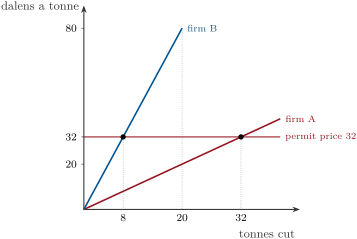
A tax fixes the price of emitting and lets the quantity adjust; a permit market fixes the quantity and lets the price adjust. Both make every polluter cut back until its cost of cutting one more unit equals the same price, so the total cut is made where it is cheapest. A uniform standard asks every source to cut the same amount, whatever it costs them; it costs more for the same total cut, unless all sources have the same costs.
Model — Tradable permits
Assumes. The authority can measure every source’s emissions; firms buy and sell permits freely.
Predicts. Emissions fall to the cap; the cuts are made by the sources that can cut most cheaply; the permit price reflects the cost of the last tonne cut.
Tested. The American market for sulphur dioxide permits, created by the Clean Air Act Amendments of 1990, performed well, and a large part of its low cost came from a change it did not plan, the earlier deregulation of the railways (Schmalensee and Stavins 2013).
Breaks. When emissions cannot be measured; when permits are given away to the firms with the best lobbyists; when courts or new rules undo the cap, as later happened to this market.
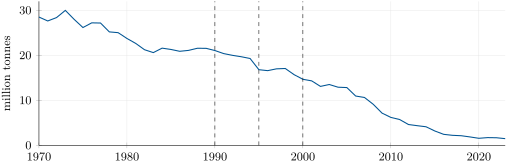
On the record — The US acid-rain programme, 1995–2010
The law of 1990 set a cap on the sulphur dioxide of American power plants and let them trade allowances. The first phase began in 1995 and the second in 2000; the final cap, from 2010, was 8.95 million tons, about half the power sector’s emissions of 1980. National emissions of the gas, from all sources, fell from 21.07 million tonnes in 1990 to 6.21 million in 2010. The chart cannot say how much of the fall the programme caused: emissions were already falling before 1990, under earlier rules.
18.4 Positive externalities
A person vaccinated against a contagious disease protects herself and, by not passing it on, others. A firm that discovers a new method teaches its rivals, who copy it. In such cases the social benefit is above the private benefit, and the market produces too little. The mirror of the Pigouvian tax is a subsidy equal to the marginal external benefit: it raises the quantity to where social benefit equals cost. Research grants, patents, and free or compulsory vaccination are its forms.
18.5 When the cure fails
The instruments need numbers that governments must estimate, and governments can get them wrong. A tax set above the marginal damage cuts the activity too far, with a deadweight loss of its own. Permits handed out free to existing firms reward past polluters and can keep newcomers out. Exemptions are won by the industries that lobby hardest. And a rule can be written in one year and undone in the next. Chapter 21 studies how such choices are made.
18.6 Exercises
Exercise 18.1 ★
A factory’s private marginal cost of the 1st to 4th tonne of output is 10, 12, 14 and 16 dalens, and each tonne causes damage of 5 to its neighbours. Give the social marginal cost of each tonne.
Solution
Solution of Exercise 18.1.
15, 17, 19 and 21 dalens.
Exercise 18.2 ★
The private cost of a flight is 300 dalens and its emissions cause damage of 45 dalens. What is its social cost? What share of it does the airline bear?
Solution
Solution of Exercise 18.2.
dalens; the airline bears of it.
Exercise 18.3 ★
Read the opening chart. Which country emitted the most sulphur dioxide per person, and in which year? At about what income per person did the United States, Britain and Japan reach their peaks?
Solution
Solution of Exercise 18.3.
The United States, in 1918, at about 191 kilograms a person. The United States peaked at about $ of GDP per person, Britain at about $ and Japan at about $.
Exercise 18.4 ★
Demand is , private marginal cost is , and the marginal damage is 20 a unit. Find the market quantity and the efficient quantity.
Solution
Solution of Exercise 18.4.
Market: , . Efficient: , .
Exercise 18.5 ★
In Exercise 18.4, what tax brings the market to the efficient quantity? What do buyers pay and sellers receive?
Solution
Solution of Exercise 18.5.
A tax of 20 a unit. At buyers pay and sellers receive , their marginal cost.
Exercise 18.6 ★★
Compute the deadweight loss of the externality in Exercise 18.4.
Solution
Solution of Exercise 18.6.
dalens.
Exercise 18.7 ★★
Demand is , private marginal cost , and the marginal damage (it grows with the quantity). Find the market and efficient quantities, the Pigouvian tax and the deadweight loss.
Solution
Solution of Exercise 18.7.
Market: , . Efficient: , . Tax: the marginal damage at 30, that is 30 a unit. Deadweight loss: between 30 and 40 the social marginal cost exceeds the demand price by , from 0 to 40, so the loss is the triangle .
Exercise 18.8 ★★
A farmer’s crops are damaged by a neighbour’s goats. Keeping the goats is worth 300 dalens a year to the neighbour; the damage is 500. Fencing them in would cost 200. What happens if the neighbour has the right to let the goats roam? If the farmer has the right to be free of them?
Solution
Solution of Exercise 18.8.
The cheapest outcome is a fence: keeping the goats fenced costs 200, against a loss of 500 if they roam and of 300 if they are given up. If the neighbour has the right, the farmer pays him between 200 and 500 to build the fence. If the farmer has the right, the neighbour fences his goats himself, since 200 is less than the 300 they are worth to him. The goats are fenced either way; only who pays changes.
Exercise 18.9 ★★
Same question if the damage is 150 a year.
Solution
Solution of Exercise 18.9.
Now letting the goats roam is cheapest: the damage, 150, is less than the fence, 200. If the neighbour has the right, the farmer would pay at most 150 for a fence costing 200: the goats roam. If the farmer has the right, the neighbour pays him between 150 and 200 a year to let the goats roam, which is cheaper than the fence. The goats roam either way.
Exercise 18.10 ★★
In the tanneries’ permit market of the figure, the cap is tightened so that the total cut must be 50 tonnes. Find the new permit price and each tannery’s cut.
Solution
Solution of Exercise 18.10.
and give and ; the permit price is 40.
Exercise 18.11 ★★
Each vaccination costs 40 dalens and is worth dalens to the -th person vaccinated; each also protects others, worth 20 dalens. Find the number vaccinated without a subsidy, the efficient number, and the subsidy that reaches it.
Solution
Solution of Exercise 18.11.
Without a subsidy: , . Efficient: , . A subsidy of 20 a vaccination, the external benefit, brings the number to 800.
Exercise 18.12 ★★★
What evidence would contradict the Coase result? Use the two studies in its model box, and say which assumption fails in each.
Solution
Solution of Exercise 18.12.
A case in which rights are clear and the parties are few, yet no deal is made, or an inefficient use continues. Farnsworth’s twenty nuisance cases: the court made the rights clear, but the parties, angry with each other, never bargained; the assumption that bargaining is cheap fails, since resentment is a cost. The Danish waterworks: the farmers knew their own losses and asked for more; the assumption that both sides know the costs fails.
Exercise 18.13 ★★★
Two firms must together cut emissions by tonnes; their costs of cutting tonnes are and , with rising marginal costs. Show that the cheapest split equalises their marginal costs, and that a tax on each tonne emitted brings it about. Why does a uniform standard generally cost more?
Solution
Solution of Exercise 18.13.
Firm 1 cuts and firm 2 ; the total cost has derivative , which is zero where the marginal costs are equal, and since both rise, that is the minimum. Under a tax , each firm cuts while cutting a tonne costs less than the tax it saves, so it stops where : both marginal costs equal , and the authority chooses so that the cuts add up to . A uniform standard gives each, which equalises marginal costs only if the two firms have the same costs.
Exercise 18.14 ★★★
In the example of the chapter, the government sets a tax of 40 a unit instead of 20. Find the quantity and the deadweight loss. Compare with no tax.
Solution
Solution of Exercise 18.14.
gives . Between 20 and 30, the units forgone were worth more than their social cost, by , from 20 to 0: a loss of , as large as with no tax at all.
Exercise 18.15 ★★★
Explain why the vaccination subsidy of Exercise 18.11 may be too small for a disease that spreads fast, and too large once almost everyone is vaccinated.
Solution
Solution of Exercise 18.15.
The external benefit of a vaccination is the infections it prevents in others. When the disease spreads fast and few are protected, one vaccination prevents many infections, worth far more than 20. When nearly everyone is vaccinated, the disease can hardly spread, and one more vaccination protects almost no one else: the external benefit falls towards zero. A fixed subsidy is too small in the first case and too large in the second.
18.7 Problem: The Tannery on the Bren
Problem 18.1
Weekend problem — a tax, a bargain and a permit market
A tannery on the river Bren produces tonnes of leather a week. Its marginal benefit from the -th tonne (price minus private cost) is dalens; each tonne releases waste that harms a fishery downstream, with marginal damage dalens. Amounts are in dalens a week.
Part I — Market and efficient outcome.
- How much does the tannery produce if it ignores the fishery?
- Find the efficient quantity.
- Compute the fishery’s total damage at each of the two quantities.
- Compute the deadweight loss of the market outcome.
- Compute the tannery’s total benefit at each quantity.
Part II — A Pigouvian tax.
- What tax per tonne is the Pigouvian tax?
- Check that the tannery chooses the efficient quantity under that tax.
- Compute the tax revenue.
- What share of the deadweight loss does the tax recover?
- If the government believed the marginal damage were , what tax would it set, and what quantity would follow?
Part III — A bargain.
- The fishery has the right to a clean river. Which quantity do the two agree on, and what is the least the tannery must pay?
- The tannery has the right to pollute. Which quantity do they agree on? Between which amounts must the fishery’s payment lie?
- Compare the two outcomes: what changes, and what does not?
- Why would bargaining fail if the waste harmed a thousand households along the river instead of one fishery?
- Name two transaction costs in this case.
Part IV — Two tanneries and permits.
- Two tanneries must together cut their waste by 40 tonnes a week. Tannery A’s marginal cost of cutting tonnes is , tannery B’s is . A standard requires 20 tonnes from each: compute each one’s total cost and the sum.
- With tradable permits for the same total, find the cuts at which the two marginal costs are equal, and the permit price.
- Compute the total cost with permits.
- Compute the saving of permits over the standard, in dalens and in percent.
- State the result of the problem: the efficient tax and the surplus it recovers, and the saving of permits over a uniform standard.
Solution
Solution of Problem 18.1.
1. : tonnes.
2. : tonnes.
3. The damage is the area under : , that is 1800 at 60 and 800 at 40.
4. Between 40 and 60 the marginal damage exceeds the marginal benefit by , from 0 to 60: the loss is .
5. : 3600 at 60 and 3200 at 40.
6. The marginal damage at the efficient quantity: 40 dalens a tonne.
7. gives .
8. dalens a week.
9. All of it: the market reaches the efficient quantity, and the 600 dalens are recovered.
10. It would set the quantity where , , with a tax of 60. With the true damage, that cuts too far: the loss between 30 and 40 is .
11. 40 tonnes. The fishery accepts if it is paid at least its damage, 800; the tannery gains 3200 from 40 tonnes and pays.
12. 40 tonnes. Cutting from 60 to 40 costs the tannery and saves the fishery : the fishery pays between 400 and 1000.
13. The quantity is 40 in both. Who pays changes: with the fishery’s right the tannery pays at least 800; with the tannery’s right the fishery pays between 400 and 1000.
14. A thousand households would have to agree among themselves and with the tannery; each would hope the others pay, and the cost of reaching and enforcing a deal would exceed the gain.
15. For example: measuring the waste and the harm to the fish; lawyers and the time spent negotiating; checking afterwards that the tannery keeps to the deal.
16. A: ; B: ; total 1000.
17. and give , ; the price is 32 dalens a tonne.
18. A: ; B: ; total 640.
19. dalens a week, 36 %.
20. The efficient tax is 40 dalens a tonne, and it recovers the whole deadweight loss of 600 dalens a week; permits for the same total cut cost 360 dalens a week (36 %) less than a uniform standard.