সব বই

পেশাদার

1 Markets I: The Ecosystem and Exchange-Traded Marketsবাজার অনলাইন 2 Markets II: Rates, FX and Creditবাজার অনলাইন 3 Markets III: Commodities, Energy and Cryptoবাজার অনলাইন 4 Quantitative Methodsপদ্ধতি অনলাইন 5 Derivatives and Volatilityডেরিভেটিভস অনলাইন 6 Rates, Credit, XVA and Riskসুদহার, ঋণ ও ঝুঁকি অনলাইন 7 Research Craft: Predictors, Backtests, Measurement, Portfoliosগবেষণা অনলাইন 8 Strategies I: Equities and Futuresকৌশল অনলাইন 9 Strategies II: Volatility, Relative Value, Macro and the Bank Desksকৌশল অনলাইন 10 Microstructure and Executionএক্সিকিউশন অনলাইন 11 Market Making and High-Frequency Tradingমার্কেট মেকিং অনলাইন 12 Machine Learning for Marketsমেশিন লার্নিং অনলাইন 13 Low-Latency Softwareপ্রযুক্তি অনলাইন 14 Networks, Hardware and Trading Infrastructureপ্রযুক্তি অনলাইন 15 Research, Data and Risk Platformsপ্রযুক্তি অনলাইন 16 The Desk and the Firmপ্রতিষ্ঠান অনলাইন 17 The Industry: Firms, Roles and Careersক্যারিয়ার অনলাইন 18 Interviews I: Maths, Probability and Speedক্যারিয়ার অনলাইন 19 Interviews II: Markets, Trading Games and the Final Roundক্যারিয়ার অনলাইন 20 Interviews III: Codeক্যারিয়ার অনলাইন
অ্যাপ পরিচিতি Coach সাইন ইন পড়া শুরু করো

বইগুলো এখনো বাংলা ভাষায় পাওয়া যায় না — ইংরেজি সংস্করণ দেখানো হচ্ছে।

Physics · পরিভাষা

Magnetostatic field কী?

Definition 28.1 University Physics — Year 1 · অধ্যায় 28 — Magnetostatics: Field, Forces, and Dipoles

Steady currents (charges in steady motion) create at every point a magnetic field B→\vect B (tesla, T\mathrm{T}), defined by the force qv→∧B→q\vect v\wedge\vect B it exerts on a moving test charge (Definition 17.1). Its field lines are tangent to B→\vect B and oriented along it. Permanent magnets create fields of the same nature, from the microscopic currents of their atoms. Orders of magnitude: Earth 5×10⁻⁵ T5 \times 10^{-5}\,\mathrm{T}; a fridge magnet 0.01 T0.01\,\mathrm{T}; an MRI scanner 1.5 T1.5\,\mathrm{T} to 3 T3\,\mathrm{T}; the largest steady laboratory fields 45 T45\,\mathrm{T}.

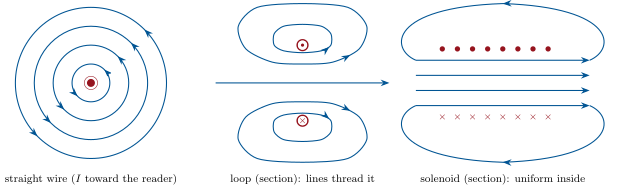
Three field maps. A dot is a current toward the reader, a cross a current away. The lines of a wire are circles; those of a loop thread it and close outside; those of a long solenoid are straight and uniform inside and close far away, where the field is weak — in every case they have neither source nor sink.

উদাহরণ

Example 28.7 (Orders of magnitude)

A 10 A10\,\mathrm{A} wire at 1 cm1\,\mathrm{cm}: B=2×10−7×10/0.01=2×10−4 TB = 2 \times 10^{-7} \times 10/0.01 = 2 \times 10^{-4}\,\mathrm{T}, four times the Earth’s field — the compass does swing. A coil of 100100 turns, radius 5 cm5\,\mathrm{cm}, 2 A2\,\mathrm{A}: μ0NI/2R=2.5 mT\mu_0NI/2R = 2.5\,\mathrm{mT} at its centre. A solenoid of 10001000 turns per metre at 5 A5\,\mathrm{A}: 6.3 mT6.3\,\mathrm{mT}; with an iron core of relative permeability 10001000, several tesla would follow if iron did not saturate near 2 T2\,\mathrm{T} — the ceiling of every electromagnet, which is why the strongest fields come from superconducting coils without iron.

প্রসঙ্গসহ পড়ো →