Physics · Glossary

What is Electrostatic field?

Definition 26.4 University Physics — Year 1 · Chapter 26 — Electrostatics: Field and Gauss’s Law

A distribution of charges at rest creates at every point MM of space an electric field E(M)\vect E(M), defined by the force it exerts on a test charge qq placed at MM: F=qE(M)\vect F = q\vect E(M) (V/m\mathrm{V}/\mathrm{m} == N/C\mathrm{N}/\mathrm{C}). A point charge q1q_1 at OO creates

E(M)=q14πε0r2er,r=OM,\vect E(M) = \frac{q_1}{4\pi\varepsilon_0 r^2}\,\vect e_r , \qquad r = OM ,

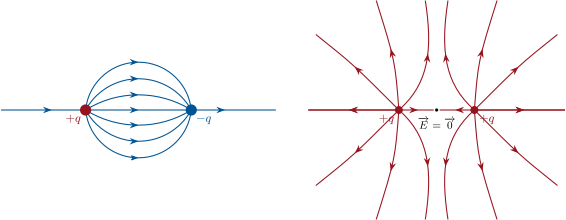
radial, outward for q1>0q_1 > 0; a distribution creates the vector sum of the fields of its elements. A field line is a curve tangent at each point to E\vect E, oriented along it.

Field lines of two opposite charges (left) and of two equal positive charges (right). Lines start on + and end on - or at infinity; on the right they repel each other and the field vanishes at the midpoint, where no line passes.
Field lines of two opposite charges (left) and of two equal positive charges (right). Lines start on ++ and end on - or at infinity; on the right they repel each other and the field vanishes at the midpoint, where no line passes.
Read in context →