
جميع الكتب

مهني

1 Markets I: The Ecosystem and Exchange-Traded Marketsالأسواق عبر الإنترنت 2 Markets II: Rates, FX and Creditالأسواق عبر الإنترنت 3 Markets III: Commodities, Energy and Cryptoالأسواق عبر الإنترنت 4 Quantitative Methodsالأساليب عبر الإنترنت 5 Derivatives and Volatilityالمشتقات عبر الإنترنت 6 Rates, Credit, XVA and Riskالفائدة والائتمان والمخاطر عبر الإنترنت 7 Research Craft: Predictors, Backtests, Measurement, Portfoliosالبحث عبر الإنترنت 8 Strategies I: Equities and Futuresالاستراتيجيات عبر الإنترنت 9 Strategies II: Volatility, Relative Value, Macro and the Bank Desksالاستراتيجيات عبر الإنترنت 10 Microstructure and Executionالتنفيذ عبر الإنترنت 11 Market Making and High-Frequency Tradingصناعة السوق عبر الإنترنت 12 Machine Learning for Marketsتعلم الآلة عبر الإنترنت 13 Low-Latency Softwareالتكنولوجيا عبر الإنترنت 14 Networks, Hardware and Trading Infrastructureالتكنولوجيا عبر الإنترنت 15 Research, Data and Risk Platformsالتكنولوجيا عبر الإنترنت 16 The Desk and the Firmالشركة عبر الإنترنت 17 The Industry: Firms, Roles and Careersالمسارات المهنية عبر الإنترنت 18 The Interview Bookالمسارات المهنية عبر الإنترنت
التطبيقات حول المدرب تسجيل الدخول ابدأ القراءة

Quantitative Finance · المسرد

ما معنى Accumulator؟

Definition 20.7 Derivatives and Volatility · الفصل 20 — FX Derivatives

An accumulator is the equity or currency analogue in which the client buys (or sells) a fixed quantity at a discounted strike on each fixing while a knock-out barrier has not been touched, and twice the quantity when the price is on the wrong side of the strike.
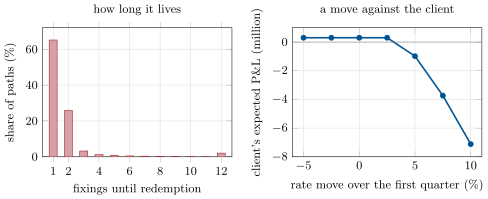
A zero-cost TARF on the chapter’s pair (client sells the dollar at 7.312, twice the notional above it, target 0.30). Left: the number of fixings before redemption: most end at the first or second. Right: the client’s expected P&L, per million of monthly notional, if the rate moves by a given amount over the first quarter; the fixings of a TARF that fails to redeem are paid at twice the notional. Data: the tutorial.
Figure 20.3. A zero-cost TARF on the chapter’s pair (client sells the dollar at 7.312, twice the notional above it, target 0.30). Left: the number of fixings before redemption: most end at the first or second. Right: the client’s expected P&L, per million of monthly notional, if the rate moves by a given amount over the first quarter; the fixings of a TARF that fails to redeem are paid at twice the notional. Data: the tutorial.

أمثلة

Example 20.8 (A TARF on the pair)

The client sells one million dollars at each of twelve monthly fixings at a strike KK: a gain of K−SK-S per dollar when the fixing is below KK, a loss of 2(S−K)2(S-K) when above, and redemption once the gains reach 0.30 per dollar. Under stochastic-local volatility (mixing 0.5) the zero-cost strike is 7.312, against a spot of 7.00 and a one-year forward of 6.861. The client is offered a rate 6.6% better than the forward. The TARF redeems in 98.1% of paths, after 1.73 fixings on average, and 95% of paths end with a gain of at least 126 000 (Figure 20.3, left). The zero value comes from the other 5%. If the rate rises by 10% over the first quarter, the client’s expected loss is 7.12 million per million of monthly notional: 1.01 million in the first quarter and the rest over nine more fixings at twice the notional. A rise of 5% costs 0.99 million, while a rise of up to 2.5% still lets the TARF redeem with the full 0.30 million (Figure 20.3, right).

اقرأ في الفصل →