 Coach
CoachAn accumulator is the equity or currency analogue in which the client buys (or sells) a fixed quantity at a discounted strike on each fixing while a knock-out barrier has not been touched, and twice the quantity when the price is on the wrong side of the strike.
Voorbeelden
Example 20.8 (A TARF on the pair)
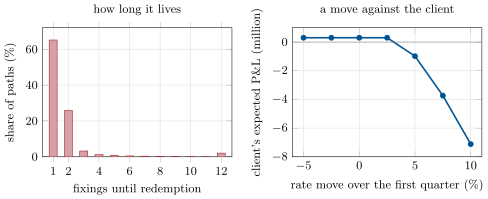
The client sells one million dollars at each of twelve monthly fixings at a strike : a gain of per dollar when the fixing is below , a loss of when above, and redemption once the gains reach 0.30 per dollar. Under stochastic-local volatility (mixing 0.5) the zero-cost strike is 7.312, against a spot of 7.00 and a one-year forward of 6.861. The client is offered a rate 6.6% better than the forward. The TARF redeems in 98.1% of paths, after 1.73 fixings on average, and 95% of paths end with a gain of at least 126 000 (Figure 20.3, left). The zero value comes from the other 5%. If the rate rises by 10% over the first quarter, the client’s expected loss is 7.12 million per million of monthly notional: 1.01 million in the first quarter and the rest over nine more fixings at twice the notional. A rise of 5% costs 0.99 million, while a rise of up to 2.5% still lets the TARF redeem with the full 0.30 million (Figure 20.3, right).