
Todos los libros

Profesional

Apps Acerca de Coach Iniciar sesión Empezar a leer

Quantitative Finance · Glosario

¿Qué es Adjustment factor?

Definition 8.10 Markets I: The Ecosystem and Exchange-Traded Markets · Capítulo 8 — Shares, Corporate Actions and Indices

The adjustment factor of a corporate action is the number ff by which every price before its ex-date is multiplied so that the adjusted series has no jump caused by the action. A back-adjusted price is the raw price times the product of the factors of all later actions.
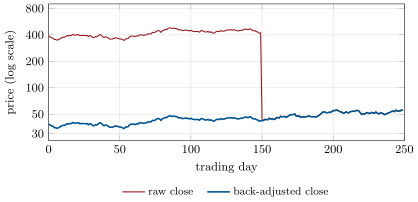
A simulated stock with a ten-for-one split on day 150 and dividends on days 60 and 200. The raw series shows a 90% fall that no holder experienced; the back-adjusted series is continuous, and all its values before day 200 differ from the prices that actually traded. Data: the chapter’s script.
Figure 8.2. A simulated stock with a ten-for-one split on day 150 and dividends on days 60 and 200. The raw series shows a 90% fall that no holder experienced; the back-adjusted series is continuous, and all its values before day 200 differ from the prices that actually traded. Data: the chapter’s script.

Ejemplos

Example 8.13 (Two basis points)

P=102P = 102, D=2D = 2, and the stock closes ex at 99, a 1% fall net of the dividend. The standard factor gives −1.000%-1.000\%; the holder earned 101/102−1=−0.980%101/102 - 1 = -0.980\%. The error, two basis points, is εD/P\varepsilon D/P. Vendors differ in which factor they publish: two “adjusted close” series for the same stock need not agree, and a research database must state its convention.

Leer en el capítulo →