
সব বই

পেশাদার

1 Markets I: The Ecosystem and Exchange-Traded Marketsবাজার অনলাইন 2 Markets II: Rates, FX and Creditবাজার অনলাইন 3 Markets III: Commodities, Energy and Cryptoবাজার অনলাইন 4 Quantitative Methodsপদ্ধতি অনলাইন 5 Derivatives and Volatilityডেরিভেটিভস অনলাইন 6 Rates, Credit, XVA and Riskসুদহার, ঋণ ও ঝুঁকি অনলাইন 7 Research Craft: Predictors, Backtests, Measurement, Portfoliosগবেষণা অনলাইন 8 Strategies I: Equities and Futuresকৌশল অনলাইন 9 Strategies II: Volatility, Relative Value, Macro and the Bank Desksকৌশল অনলাইন 10 Microstructure and Executionএক্সিকিউশন অনলাইন 11 Market Making and High-Frequency Tradingমার্কেট মেকিং অনলাইন 12 Machine Learning for Marketsমেশিন লার্নিং অনলাইন 13 Low-Latency Softwareপ্রযুক্তি অনলাইন 14 Networks, Hardware and Trading Infrastructureপ্রযুক্তি অনলাইন 15 Research, Data and Risk Platformsপ্রযুক্তি অনলাইন 16 The Desk and the Firmপ্রতিষ্ঠান অনলাইন 17 The Industry: Firms, Roles and Careersক্যারিয়ার অনলাইন 18 Interviews I: Maths, Probability and Speedক্যারিয়ার অনলাইন 19 Interviews II: Markets, Trading Games and the Final Roundক্যারিয়ার অনলাইন 20 Interviews III: Codeক্যারিয়ার অনলাইন
অ্যাপ পরিচিতি Coach সাইন ইন পড়া শুরু করো

বইগুলো এখনো বাংলা ভাষায় পাওয়া যায় না — ইংরেজি সংস্করণ দেখানো হচ্ছে।

Quantitative Finance · পরিভাষা

Attention mechanism, transformer কী?

অন্য নাম: attention mechanism · transformer

Definition 8.4 Machine Learning for Markets · অধ্যায় 8 — Sequence Models on Order Books

An attention mechanism lets each position of a sequence form its output as a weighted average of all positions: with queries Q=ZAQ\mathsf Q = ZA_{\mathsf Q}, keys K=ZAK\mathsf K = ZA_{\mathsf K} and values V=ZAV\mathsf V = ZA_{\mathsf V} computed from the sequence ZZ (T×hT\times h), the output is softmax(QK⊤/h)V\mathrm{softmax}(\mathsf Q\mathsf K^\top/\sqrt h)\mathsf V. A transformer layer combines several attention heads, a position-wise network, residual connections and layer normalisation; positions are encoded by adding learned or fixed vectors to the inputs (Vaswani et al., 2017).
Information coefficient of ( up) - ( down) with the forward change, averaged over eight test sessions (and two seeds for the sequence models); bars show the standard deviation across sessions and seeds. The logistic regression reads ten hand-made features at the decision time; the sequence models read the raw ten-level book over ten seconds. Data: ml_lobseq.table.
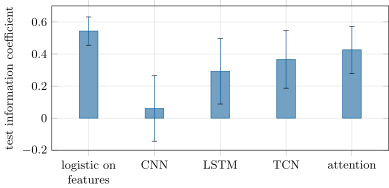
Figure 8.2. Information coefficient of P(up)−P(down)\P(\text{up}) - \P(\text{down}) with the forward change, averaged over eight test sessions (and two seeds for the sequence models); bars show the standard deviation across sessions and seeds. The logistic regression reads ten hand-made features at the decision time; the sequence models read the raw ten-level book over ten seconds. Data: ml_lobseq.table.
প্রসঙ্গসহ পড়ো →