 Coach
CoachIn a call auction orders are collected for a period without being executed; at the end of it a single uncrossing price is computed, and every order that can trade at that price does, at that price. Opening and closing auctions, volatility interruptions and initial public offerings are call auctions; so, in miniature, are the periodic auctions of Definition 11.9.
Examples
Example 13.3 (Eight orders)
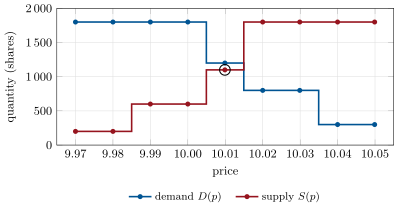
Buyers: 300 at market; 500 at 10.03; 400 at 10.01; 600 at 10.00. Sellers: 200 at market; 400 at 9.99; 500 at 10.01; 700 at 10.02. The reference price is 10.00.
| Price | Executable | Surplus | ||
|---|---|---|---|---|
| 9.99 | 1 800 | 600 | 600 | |
| 10.00 | 1 800 | 600 | 600 | |
| 10.01 | 1 200 | 1 100 | 1 100 | |
| 10.02 | 800 | 1 800 | 800 | |
| 10.03 | 800 | 1 800 | 800 |
Rule 1 alone selects 10.01: 1 100 shares trade. On the buy side the market order (300) and the order at 10.03 (500) are filled in full and the order at 10.01 receives 300 of its 400; on the sell side everything up to 10.01 is filled. A buy surplus of 100 shares remains at 10.01, and that is what the exchange publishes as the closing imbalance.