
সব বই

পেশাদার

1 Markets I: The Ecosystem and Exchange-Traded Marketsবাজার অনলাইন 2 Markets II: Rates, FX and Creditবাজার অনলাইন 3 Markets III: Commodities, Energy and Cryptoবাজার অনলাইন 4 Quantitative Methodsপদ্ধতি অনলাইন 5 Derivatives and Volatilityডেরিভেটিভস অনলাইন 6 Rates, Credit, XVA and Riskসুদহার, ঋণ ও ঝুঁকি অনলাইন 7 Research Craft: Predictors, Backtests, Measurement, Portfoliosগবেষণা অনলাইন 8 Strategies I: Equities and Futuresকৌশল অনলাইন 9 Strategies II: Volatility, Relative Value, Macro and the Bank Desksকৌশল অনলাইন 10 Microstructure and Executionএক্সিকিউশন অনলাইন 11 Market Making and High-Frequency Tradingমার্কেট মেকিং অনলাইন 12 Machine Learning for Marketsমেশিন লার্নিং অনলাইন 13 Low-Latency Softwareপ্রযুক্তি অনলাইন 14 Networks, Hardware and Trading Infrastructureপ্রযুক্তি অনলাইন 15 Research, Data and Risk Platformsপ্রযুক্তি অনলাইন 16 The Desk and the Firmপ্রতিষ্ঠান অনলাইন 17 The Industry: Firms, Roles and Careersক্যারিয়ার অনলাইন 18 Interviews I: Maths, Probability and Speedক্যারিয়ার অনলাইন 19 Interviews II: Markets, Trading Games and the Final Roundক্যারিয়ার অনলাইন 20 Interviews III: Codeক্যারিয়ার অনলাইন
অ্যাপ পরিচিতি Coach সাইন ইন পড়া শুরু করো

বইগুলো এখনো বাংলা ভাষায় পাওয়া যায় না — ইংরেজি সংস্করণ দেখানো হচ্ছে।

Quantitative Finance · পরিভাষা

Context switch, busy polling, kernel bypass কী?

অন্য নাম: context switch · busy polling · kernel bypass

Definition 13.5 Low-Latency Software · অধ্যায় 13 — Linux Tuning

A context switch is the kernel saving the state of the thread running on a CPU and restoring another’s; a thread that blocks waiting for data gives its CPU away and is switched back in when the data arrives. Busy polling checks for new data in a loop that never blocks, keeping the CPU. Kernel bypass moves the network card’s receive and transmit queues into the application’s address space, so that packets reach the program without a system call, an interrupt or the kernel’s network stack.
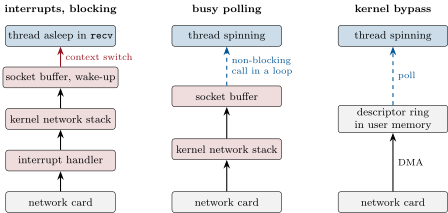
Three ways for a packet to reach a thread. Left: the card interrupts a CPU, the kernel processes the packet, and the sleeping thread is switched back in. Middle: the thread never sleeps and polls the socket. Right: the card writes into queues mapped into the program, which polls them; the kernel is not on the path (DMA: direct memory access, chapter 4). Shaded red: the kernel’s work on the path.
Figure 13.3. Three ways for a packet to reach a thread. Left: the card interrupts a CPU, the kernel processes the packet, and the sleeping thread is switched back in. Middle: the thread never sleeps and polls the socket. Right: the card writes into queues mapped into the program, which polls them; the kernel is not on the path (DMA: direct memory access, chapter 4). Shaded red: the kernel’s work on the path.
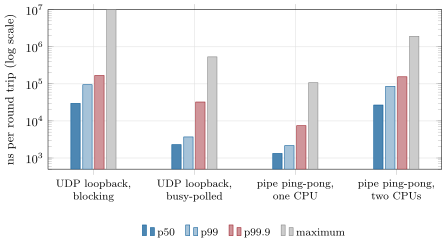
Round trips of 64 bytes between two pinned threads over loopback UDP, receiving with a blocking call or with non-blocking calls in a loop, and of one byte through two pipes with both threads on one CPU or on two; 100 000 round trips each. Measured on a laptop (Intel Core Ultra 7 155H) under WSL2, no isolated cores. Data: bench_tuning.py.
Figure 13.4. Round trips of 64 bytes between two pinned threads over loopback UDP, receiving with a blocking call or with non-blocking calls in a loop, and of one byte through two pipes with both threads on one CPU or on two; 100 000 round trips each. Measured on a laptop (Intel Core Ultra 7 155H) under WSL2, no isolated cores. Data: bench_tuning.py.
প্রসঙ্গসহ পড়ো →