সব বই

পেশাদার

1 Markets I: The Ecosystem and Exchange-Traded Marketsবাজার অনলাইন 2 Markets II: Rates, FX and Creditবাজার অনলাইন 3 Markets III: Commodities, Energy and Cryptoবাজার অনলাইন 4 Quantitative Methodsপদ্ধতি অনলাইন 5 Derivatives and Volatilityডেরিভেটিভস অনলাইন 6 Rates, Credit, XVA and Riskসুদহার, ঋণ ও ঝুঁকি অনলাইন 7 Research Craft: Predictors, Backtests, Measurement, Portfoliosগবেষণা অনলাইন 8 Strategies I: Equities and Futuresকৌশল অনলাইন 9 Strategies II: Volatility, Relative Value, Macro and the Bank Desksকৌশল অনলাইন 10 Microstructure and Executionএক্সিকিউশন অনলাইন 11 Market Making and High-Frequency Tradingমার্কেট মেকিং অনলাইন 12 Machine Learning for Marketsমেশিন লার্নিং অনলাইন 13 Low-Latency Softwareপ্রযুক্তি অনলাইন 14 Networks, Hardware and Trading Infrastructureপ্রযুক্তি অনলাইন 15 Research, Data and Risk Platformsপ্রযুক্তি অনলাইন 16 The Desk and the Firmপ্রতিষ্ঠান অনলাইন 17 The Industry: Firms, Roles and Careersক্যারিয়ার অনলাইন 18 Interviews I: Maths, Probability and Speedক্যারিয়ার অনলাইন 19 Interviews II: Markets, Trading Games and the Final Roundক্যারিয়ার অনলাইন 20 Interviews III: Codeক্যারিয়ার অনলাইন
অ্যাপ পরিচিতি Coach সাইন ইন পড়া শুরু করো

বইগুলো এখনো বাংলা ভাষায় পাওয়া যায় না — ইংরেজি সংস্করণ দেখানো হচ্ছে।

Quantitative Finance · পরিভাষা

CPU affinity, core isolation, housekeeping core কী?

অন্য নাম: CPU affinity · core isolation · housekeeping core

Definition 13.1 Low-Latency Software · অধ্যায় 13 — Linux Tuning

The CPU affinity of a thread is the set of CPUs the scheduler may run it on; it is set with sched_setaffinity (or taskset from a shell) and inherited by the threads a thread creates. Core isolation removes CPUs from the scheduler’s load balancing, so that no thread runs on them unless its affinity names them explicitly, and moves the kernel’s own unbound work away from them. A housekeeping core is a CPU left out of the isolated set, which runs everything else: the kernel’s work, the interrupts of devices the hot path does not use, and the process’s cold threads.
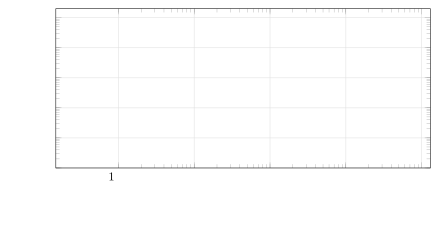
The hiccup meter: how often a thread spinning on the time-stamp counter is kept from running for at least x, over five seconds, pinned to a CPU no other program of ours uses, free to move, and pinned to a CPU shared with a second spinning thread. Measured on a laptop (Intel Core Ultra 7 155H) under WSL2, no isolated cores, benchmark at normal priority on an otherwise idle machine. Data: bench_tuning.py.
Figure 13.1. The hiccup meter: how often a thread spinning on the time-stamp counter is kept from running for at least xx, over five seconds, pinned to a CPU no other program of ours uses, free to move, and pinned to a CPU shared with a second spinning thread. Measured on a laptop (Intel Core Ultra 7 155H) under WSL2, no isolated cores, benchmark at normal priority on an otherwise idle machine. Data: bench_tuning.py.
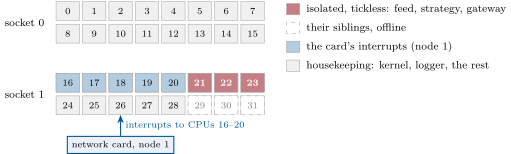
A tuned host for chapter 4’s two-socket fixture: each column is a physical core with its two hardware threads. The boot line isolcpus=21-23,29-31 nohz_full=21-23 rcu_nocbs=21-23 irqaffinity=0-15 with the siblings taken offline, the card’s interrupt queues bound to CPUs 16–20; the build’s audit accepts this host (the tuned fixture).
Figure 13.2. A tuned host for chapter 4’s two-socket fixture: each column is a physical core with its two hardware threads. The boot line isolcpus=21-23,29-31 nohz_full=21-23 rcu_nocbs=21-23 irqaffinity=0-15 with the siblings taken offline, the card’s interrupt queues bound to CPUs 16–20; the build’s audit accepts this host (the tuned fixture).
প্রসঙ্গসহ পড়ো →