सभी किताबें

पेशेवर

1 Markets I: The Ecosystem and Exchange-Traded Marketsबाज़ार ऑनलाइन 2 Markets II: Rates, FX and Creditबाज़ार ऑनलाइन 3 Markets III: Commodities, Energy and Cryptoबाज़ार ऑनलाइन 4 Quantitative Methodsविधियाँ ऑनलाइन 5 Derivatives and Volatilityडेरिवेटिव्स ऑनलाइन 6 Rates, Credit, XVA and Riskब्याज दरें, क्रेडिट और जोखिम ऑनलाइन 7 Research Craft: Predictors, Backtests, Measurement, Portfoliosअनुसंधान ऑनलाइन 8 Strategies I: Equities and Futuresरणनीतियाँ ऑनलाइन 9 Strategies II: Volatility, Relative Value, Macro and the Bank Desksरणनीतियाँ ऑनलाइन 10 Microstructure and Executionनिष्पादन ऑनलाइन 11 Market Making and High-Frequency Tradingमार्केट मेकिंग ऑनलाइन 12 Machine Learning for Marketsमशीन लर्निंग ऑनलाइन 13 Low-Latency Softwareतकनीक ऑनलाइन 14 Networks, Hardware and Trading Infrastructureतकनीक ऑनलाइन 15 Research, Data and Risk Platformsतकनीक ऑनलाइन 16 The Desk and the Firmफ़र्म ऑनलाइन 17 The Industry: Firms, Roles and Careersकरियर ऑनलाइन 18 Interviews I: Maths, Probability and Speedकरियर ऑनलाइन 19 Interviews II: Markets, Trading Games and the Final Roundकरियर ऑनलाइन 20 Interviews III: Codeकरियर ऑनलाइन
ऐप्स परिचय Coach लॉग इन पढ़ना शुरू करें

Quantitative Finance · शब्दावली

CPU affinity, core isolation, housekeeping core क्या है?

अन्य नाम: CPU affinity · core isolation · housekeeping core

Definition 13.1 Low-Latency Software · अध्याय 13 — Linux Tuning

The CPU affinity of a thread is the set of CPUs the scheduler may run it on; it is set with sched_setaffinity (or taskset from a shell) and inherited by the threads a thread creates. Core isolation removes CPUs from the scheduler’s load balancing, so that no thread runs on them unless its affinity names them explicitly, and moves the kernel’s own unbound work away from them. A housekeeping core is a CPU left out of the isolated set, which runs everything else: the kernel’s work, the interrupts of devices the hot path does not use, and the process’s cold threads.
The hiccup meter: how often a thread spinning on the time-stamp counter is kept from running for at least x, over five seconds, pinned to a CPU no other program of ours uses, free to move, and pinned to a CPU shared with a second spinning thread. Measured on a laptop (Intel Core Ultra 7 155H) under WSL2, no isolated cores, benchmark at normal priority on an otherwise idle machine. Data: bench_tuning.py.
Figure 13.1. The hiccup meter: how often a thread spinning on the time-stamp counter is kept from running for at least xx, over five seconds, pinned to a CPU no other program of ours uses, free to move, and pinned to a CPU shared with a second spinning thread. Measured on a laptop (Intel Core Ultra 7 155H) under WSL2, no isolated cores, benchmark at normal priority on an otherwise idle machine. Data: bench_tuning.py.
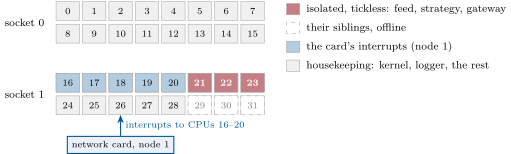
A tuned host for chapter 4’s two-socket fixture: each column is a physical core with its two hardware threads. The boot line isolcpus=21-23,29-31 nohz_full=21-23 rcu_nocbs=21-23 irqaffinity=0-15 with the siblings taken offline, the card’s interrupt queues bound to CPUs 16–20; the build’s audit accepts this host (the tuned fixture).
Figure 13.2. A tuned host for chapter 4’s two-socket fixture: each column is a physical core with its two hardware threads. The boot line isolcpus=21-23,29-31 nohz_full=21-23 rcu_nocbs=21-23 irqaffinity=0-15 with the siblings taken offline, the card’s interrupt queues bound to CPUs 16–20; the build’s audit accepts this host (the tuned fixture).
अध्याय में पढ़ें →