
جميع الكتب

مهني

1 Markets I: The Ecosystem and Exchange-Traded Marketsالأسواق عبر الإنترنت 2 Markets II: Rates, FX and Creditالأسواق عبر الإنترنت 3 Markets III: Commodities, Energy and Cryptoالأسواق عبر الإنترنت 4 Quantitative Methodsالأساليب عبر الإنترنت 5 Derivatives and Volatilityالمشتقات عبر الإنترنت 6 Rates, Credit, XVA and Riskالفائدة والائتمان والمخاطر عبر الإنترنت 7 Research Craft: Predictors, Backtests, Measurement, Portfoliosالبحث عبر الإنترنت 8 Strategies I: Equities and Futuresالاستراتيجيات عبر الإنترنت 9 Strategies II: Volatility, Relative Value, Macro and the Bank Desksالاستراتيجيات عبر الإنترنت 10 Microstructure and Executionالتنفيذ عبر الإنترنت 11 Market Making and High-Frequency Tradingصناعة السوق عبر الإنترنت 12 Machine Learning for Marketsتعلم الآلة عبر الإنترنت 13 Low-Latency Softwareالتكنولوجيا عبر الإنترنت 14 Networks, Hardware and Trading Infrastructureالتكنولوجيا عبر الإنترنت 15 Research, Data and Risk Platformsالتكنولوجيا عبر الإنترنت 16 The Desk and the Firmالشركة عبر الإنترنت 17 The Industry: Firms, Roles and Careersالمسارات المهنية عبر الإنترنت 18 The Interview Bookالمسارات المهنية عبر الإنترنت
التطبيقات حول المدرب تسجيل الدخول ابدأ القراءة

Quantitative Finance · المسرد

ما معنى Direct market access and sponsored access؟

يُعرف أيضًا باسم: direct market access · sponsored access

Definition 4.8 Markets I: The Ecosystem and Exchange-Traded Markets · الفصل 4 — Exchanges, Brokers and Venues

Under direct market access (DMA) a client sends orders through the broker’s systems, which check them and pass them to the exchange under the broker’s membership. Under sponsored access the client connects to the exchange directly, with its own lines and machines, using the broker’s membership identifier; the broker’s risk checks are applied to that flow without its passing through the broker’s order-handling infrastructure.
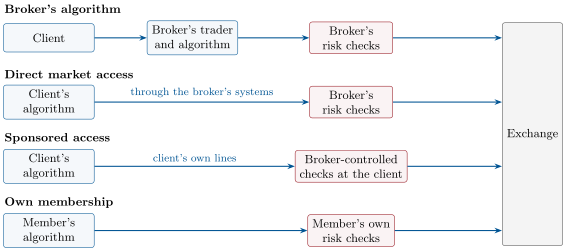
Four ways to reach the same matching engine, from slowest and cheapest to set up (top) to fastest and most demanding (bottom). In every row a regulated firm’s pre-trade checks (red) sit between the algorithm and the exchange: what changes is whose they are and where they run.
Figure 4.2. Four ways to reach the same matching engine, from slowest and cheapest to set up (top) to fastest and most demanding (bottom). In every row a regulated firm’s pre-trade checks (red) sit between the algorithm and the exchange: what changes is whose they are and where they run.
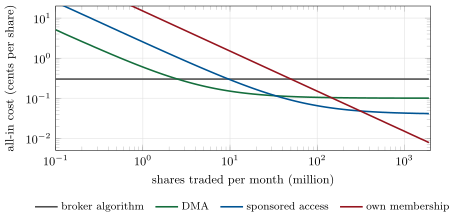
Cost per share of four access models against monthly volume (both axes logarithmic). The cheapest model changes three times over four decades of volume. Data: the illustrative charges of , computed by the chapter’s script.
Figure 4.3. Cost per share of four access models against monthly volume (both axes logarithmic). The cheapest model changes three times over four decades of volume. Data: the illustrative charges of Example 4.11, computed by the chapter’s script.

أمثلة

Example 4.11 (Four models, three crossovers)

Take illustrative charges of 0.30 cent a share with no fixed cost for a broker’s algorithm; 0.10 cent plus $5 000 a month for DMA; 0.04 cent plus $25 000 a month for sponsored access (the client now pays for its own lines and colocation); and $150 000 a month with no per-share charge for a firm’s own membership (compliance, capital, memberships). The crossovers are 5 000/0.002=2.55\,000/0.002 = 2.5 million shares a month, 20 000/0.0006=3320\,000/0.0006 = 33 million, and 125 000/0.0004=313125\,000/0.0004 = 313 million. A firm trading 15 million shares a day is past the last one; a fund trading one million a month should not even consider DMA (Figure 4.3).

اقرأ في الفصل →