Markets I: The Ecosystem and Exchange-Traded Markets · Markets
4Exchanges, Brokers and Venues
The company that owns the New York Stock Exchange earned more in 2025 from selling data and network connections at its exchanges than from every share and every stock option traded on them. The famous floor is a small part of a business that lists companies, matches orders, clears trades, rents cabinets in a data centre and licenses the record of what happened. A trading firm is a customer of all five — and cannot send a single order before deciding through whom, and under whose name, it reaches the matching engine. This chapter describes what an exchange sells, the chain of intermediaries between a trader and the match, and the zoo of venues that are not exchanges.
4.1 What an exchange sells
Definition 4.1 (Order)
An order is a binding instruction to buy or to sell a stated quantity of an instrument, carrying at least a side, a quantity, a price condition (a limit, or “at market”) and a validity. It remains the responsibility of whoever sent it until it is executed, cancelled or expired.
Definition 4.2 (Exchange)
An exchange is a regulated organisation that admits instruments to trading, admits members, and operates a system in which members’ orders interact under public, non-discretionary rules to form trades and prices. It supervises its own market and is itself supervised by a public authority.
The definition hides five products, sold to different customers.
Method 4.3 (Reading an exchange group’s revenue)
Sort each revenue line into:
- Listing — paid by issuers, annually, for admission to trading.
- Transaction — paid by members per share, contract or unit of value matched, net of any rebates paid back to them.
- Clearing — where the group owns the clearing house (Chapter 5), paid per trade cleared and earned on collateral held.
- Data — licences for real-time and historical prices, paid by everyone who looks at or computes on them.
- Access — ports, cross-connects, cabinets and power in the exchange’s data centre, paid by whoever needs to be close (One Quant Book 14).
Lines 1, 4 and 5 recur whatever volumes do; 2 and 3 move with the market. Divide 2 and 3 by the volume to obtain the revenue per contract or per share: the price of the exchange’s core service.
As of September 2026 — Two exchange groups in their own numbers
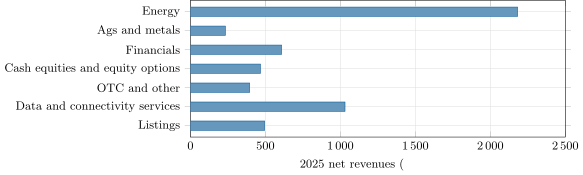
Intercontinental Exchange, owner of the New York Stock Exchange, reported 2025 net revenues of $9.9 billion, of which $5 411 million in its Exchanges segment: energy $2 182 million, agricultural products and metals $233 million, financial futures $608 million, cash equities and equity options $467 million, over-the-counter and other $395 million, data and connectivity services $1 031 million, listings $495 million. CME Group reported 2025 revenue of $6.5 billion, of which $5 281 million in clearing and transaction fees and $803 million in market data; its average rate per contract was $0.696.
Example 4.4 (What a futures contract pays its exchange)
At $0.696 a contract, $5 281 million of clearing and transaction fees correspond to about 7.6 billion contract sides charged in the year, some 30 million per trading day. A single equity index contract controls several hundred thousand dollars of stock: the exchange’s fee is a small fraction of a basis point of the value traded. Exchanges are, like market makers, a business of tiny numbers multiplied by enormous ones — with the difference that an exchange’s customers cannot easily take a contract elsewhere.
Remark 4.5 (Why futures exchanges earn more than stock exchanges)
A share is the same share on every venue: US and European law force competition between stock exchanges, and matching fees were competed down to almost nothing. A futures contract is a creature of the exchange that lists it and clears at that exchange’s clearing house; a position opened there can only be closed there. The “vertical silo” of listing, matching and clearing is why Figure 4.1 looks the way it does.
4.2 Members, brokers and access
Definition 4.6 (Exchange member)
An exchange member (or participant) is a firm admitted by the exchange to send orders to its system in its own name. It must be authorised by a regulator, meet capital requirements, accept the rulebook, and have an arrangement to clear its trades.
Definition 4.7 (Broker)
A broker is a member that sends orders on behalf of clients who are not members. The exchange knows only the broker: towards the market the broker is responsible for every order, and for paying for every trade, of every client behind it.
That last sentence explains the structure of the industry. Because the broker answers for its clients, it must control what they send; because the controls take time, the fastest firms want to avoid them; and regulators decide how far they may.
Definition 4.8 (Direct market access and sponsored access)
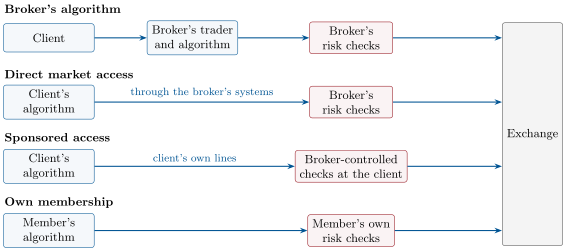
Under direct market access (DMA) a client sends orders through the broker’s systems, which check them and pass them to the exchange under the broker’s membership. Under sponsored access the client connects to the exchange directly, with its own lines and machines, using the broker’s membership identifier; the broker’s risk checks are applied to that flow without its passing through the broker’s order-handling infrastructure.
Remark 4.9 (The end of naked access)
Until 2010 some US brokers lent their identifier to fast clients with no pre-trade control at all (“naked” access). On 3 November 2010 the SEC adopted Rule 15c3-5, the market access rule: a broker-dealer with market access, or providing it, must apply pre-trade risk controls — credit and capital thresholds, rejection of erroneous orders, regulatory checks — that are under its direct and exclusive control. European rules on algorithmic trading and direct electronic access impose the equivalent. The checks a firm builds to satisfy them are a component of the miniature firm of this series (One Quant Book 13); what they must catch is the lesson of the 2012 incident studied there.
Method 4.10 (Choosing an access model)
- Latency need. If the strategy competes on speed at the matching engine, only sponsored access or membership will do.
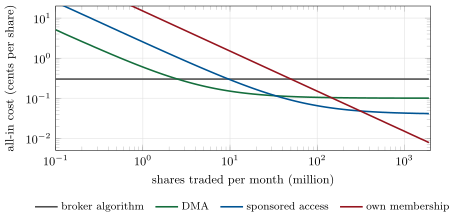
- Volume. Compute the all-in monthly cost of each model (fixed cost , per-share charge , volume ) and find the crossover volumes .
- Regulatory appetite. Membership means becoming a regulated broker-dealer or investment firm: capital, compliance staff, reporting, examinations.
- Counterparty. A broker can cut a client off in a crisis; a member depends only on its clearing firm (Chapter 5).
The decision is revisited as the firm grows; Chapters 29 and 30 work through real fee schedules.
Example 4.11 (Four models, three crossovers)
Take illustrative charges of 0.30 cent a share with no fixed cost for a broker’s algorithm; 0.10 cent plus $5 000 a month for DMA; 0.04 cent plus $25 000 a month for sponsored access (the client now pays for its own lines and colocation); and $150 000 a month with no per-share charge for a firm’s own membership (compliance, capital, memberships). The crossovers are million shares a month, million, and million. A firm trading 15 million shares a day is past the last one; a fund trading one million a month should not even consider DMA (Figure 4.3).
4.3 Venues that are not exchanges
Matching orders under rules does not require an exchange licence.
Definition 4.12 (Alternative trading system)
In US law an alternative trading system (ATS) is a system that brings together buyers and sellers of securities as an exchange does but is operated by a broker-dealer under Regulation ATS (adopted in December 1998) instead of registering as an exchange. It does not list securities and does not regulate its participants.
Definition 4.13 (Multilateral trading facility)
In EU law a multilateral trading facility (MTF) is a multilateral system, operated by an investment firm or a market operator, which brings together multiple third-party buying and selling interests in financial instruments, under non-discretionary rules, in a way that results in a contract.
Most dark pools (Chapter 9) are ATSs; the large pan-European stock venues that compete with the national exchanges are MTFs (Chapter 11). Both trade instruments that an exchange listed, free-riding on its listing and supervision work, which is one reason exchanges charge what they do for data.
Proposition 4.14 (Break-even share of a new venue)
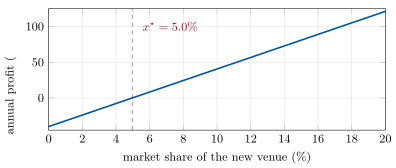
A venue with annual fixed costs enters a market trading shares a day over days a year. It keeps a net fee per share matched and earns market-data revenue in proportion to its share, at 100%. Its profit at market share is and its break-even share is
Proof. Matched volume is shares a year, each earning ; data revenue is ; costs are fixed. ∎
Example 4.15 (Five percent or nothing)
With billion shares a day, , cent, million and million, . At a 10% share the venue earns $40.6 million; at 2% it loses $23.9 million. But share is not a free parameter: traders send orders where they expect to be filled, that is, where the other orders already are. A new venue must buy its first percent — with rebates above its fees, with equity stakes offered to the brokers who route to it, or with a rule that some group of traders values (a speed bump, a midpoint book). Liquidity attracts liquidity; the history of venues is a short list of survivors.
4.4 The consolidated view
Definition 4.16 (Market data feed)
A market data feed is the stream of messages by which a venue publishes its orders, quotes and trades. A consolidated feed merges the feeds of all venues trading the same instruments into one best bid, one best offer and one tape of trades.
Once one share trades in twenty places, three problems appear, and each gets its own chapter. What is the price? Somebody must merge the feeds, and the merged view is always a little older than its sources (Chapters 9 and 28). Where should an order go? A broker’s duty of best execution becomes a routing problem solved by software (One Quant Book 10). Who supervises a manipulation that uses three venues at once? Cross-market surveillance is the regulators’ answer, and its detectors are in One Quant Book 9.
Remark 4.17 (Every venue has a code)
Systems identify venues by the four-character market identifier code of ISO 10383: XNYS is the New York Stock Exchange, XNAS Nasdaq. An operating code names the organisation and segment codes name its individual markets; the registry is published monthly and is free. The code, not the name, is what appears in trade reports, routing tables and this chapter’s build.
4.5 Tutorial: reading an exchange’s accounts
Goal. Turn two earnings releases into the quantities a trading firm cares about, then compute the access crossovers. End state: the shares quoted in Figure 4.1 and the three crossovers of Example 4.11.
Enter the published lines, with their source in a comment — a number without a source is a rumour.
# ICE, Exchanges segment, full-year 2025 net revenues, USD million (ledger row F1)
ICE_EXCHANGES_2025 = {
    "Energy": 2182, "Ags and metals": 233, "Financials": 608,
    "Cash equities and equity options": 467, "OTC and other": 395,
    "Data and connectivity services": 1031, "Listings": 495,
}
ICE_TRANSACTION = ("Energy", "Ags and metals", "Financials", "Cash equities and equity options",
                   "OTC and other")
# CME Group, full-year 2025, USD million (ledger row F2)
CME_2025 = {"Clearing and transaction fees": 5281.1, "Market data and information services": 803.1}
CME_TOTAL_2025 = 6500.0
CME_RATE_PER_CONTRACT = 0.696
Listing 4.1. Two groups’ 2025 revenue lines as data. code/markets-1/04-exchanges-brokers-venues/python/venue_econ.py - Compute shares. Recurring lines (data, connectivity, listings) are of the segment; cash equities and equity options ; energy . At CME, clearing and transaction fees are of revenue and market data .
Model the access decision.
@dataclass(frozen=True)
class AccessModel:
    name: str
    per_share: float      # USD per share, paid to the access provider
    fixed_month: float    # USD per month: connectivity, colocation, compliance, capital cost


ACCESS = (
    AccessModel("broker algorithm", 0.0030, 0.0),
    AccessModel("direct market access", 0.0010, 5_000.0),
    AccessModel("sponsored access", 0.0004, 25_000.0),
    AccessModel("own membership", 0.0, 150_000.0),
)


def monthly_cost(m: AccessModel, shares_month: float) -> float:
    return m.fixed_month + m.per_share * shares_month


def cheapest(shares_month: float) -> AccessModel:
    return min(ACCESS, key=lambda m: monthly_cost(m, shares_month))


def crossover(a: AccessModel, b: AccessModel) -> float:
    """Monthly volume at which b becomes cheaper than a (b has the higher fixed cost)."""
    return (b.fixed_month - a.fixed_month) / (a.per_share - b.per_share)
Listing 4.2. Access models as data, their monthly cost and the crossover volume. code/markets-1/04-exchanges-brokers-venues/python/venue_econ.py - Find the cheapest model at 1, 10, 100 and 1 000 million shares a month: broker algorithm, DMA, sponsored access, own membership.
What to change next. Add a latency column and exclude models slower than a threshold: the cheapest admissible model at 5 million shares a month changes. Then add the exchange’s own tiered fees (Chapter 29), which depend on volume too.
4.6 Build: the venue registry
Purpose. Every order, fill, fee and market-data message in the miniature firm names a venue. The registry is the one place that knows what each venue is.
Interface. Venue(mic, operating_mic, name, kind, country, currency, fee_model) with kind in exchange, ats, mtf, si, otc; and Registry.load(csv_path), get(mic), by_kind(kind), segments_of(operating_mic).
Rules. Codes are four upper-case alphanumerics; a duplicate code, an unknown kind or a segment whose operating code is absent is rejected at load time, not at first use. The registry is immutable after loading.
Acceptance tests. code/firm/venues/tests/, run against the sample file data/markets-1/venues_sample.csv.
Stretch. Load the full ISO 10383 file from the registration authority and report how many active segment codes each operating code has.
Sources and further reading
- Intercontinental Exchange, Intercontinental Exchange Reports Strong Full Year 2025 Results, 5 February 2026.
- CME Group, CME Group Inc. Reports Fourth Consecutive Year of Record Annual Revenue, 4 February 2026.
- US Securities and Exchange Commission, SEC Adopts New Rule Preventing Unfiltered Market Access, press release 2010-210, and Release 34-63241 (Rule 15c3-5).
- 17 CFR 242.300 (Regulation ATS, definitions); Directive 2014/65/EU (MiFID II), article 4(1)(22).
- ISO 10383 Registration Authority, Market identifier codes.
- L. Harris, Trading and Exchanges, Oxford University Press, 2003, chapters 3, 7 and 26.
4.7 Exercises
Exercise 4.1 ★
From Box 4.1, compute for the ICE Exchanges segment the share of each of: energy; cash equities and equity options; data and connectivity; listings.
Solution
Solution of Exercise 4.1.
Of $5 411 million: energy 40.3%; cash equities and equity options 8.6%; data and connectivity 19.1%; listings 9.1%.
Exercise 4.2 ★
A futures contract has a notional value of $280 000 and the exchange earns $0.70 per side. Express the fee of a round trip (buy then sell) in basis points of the notional.
Solution
Solution of Exercise 4.2.
: . A stock trade on the same value would pay far more in spread alone.
Exercise 4.3 ★
For each situation name the access model and say whose pre-trade risk checks apply: (a) a fund manager phones an order to a sales-trader; (b) a quantitative fund’s algorithm sends orders through its broker’s gateway; (c) a trading firm colocated at the exchange uses its broker’s identifier; (d) a market maker registered as a broker-dealer.
Solution
Solution of Exercise 4.3.
(a) Broker’s algorithm or desk; the broker’s checks. (b) Direct market access; the broker’s checks, in the broker’s systems. (c) Sponsored access; still the broker’s checks, under its exclusive control, although they run beside the client’s machines. (d) Own membership; the firm’s own checks, for which it answers to its regulator and to its clearing firm.
Exercise 4.4 ★★
A firm trades 60 million shares a month. With the charges of Example 4.11, compute the monthly cost of each model and the saving of the best over the second best. At what monthly volume does it become worth applying for membership?
Solution
Solution of Exercise 4.4.
$180 000; $65 000; $49 000; $150 000. Sponsored access saves $16 000 a month over DMA. Membership wins above 312.5 million shares a month, five times this firm’s volume.
Exercise 4.5 ★★
A sponsored-access provider raises its per-share charge from 0.04 to 0.06 cent. Recompute the two crossovers that involve sponsored access. Which kind of client does the increase push away?
Solution
Solution of Exercise 4.5.
DMA to sponsored: million shares a month (was 33). Sponsored to membership: million (was 313). The range in which sponsored access is best shrinks from both ends: the provider loses its smallest clients to DMA and pushes its largest to become members — the ones who paid it most.
Exercise 4.6 ★★
With the parameters of Example 4.15, the incumbents cut their fees and the new venue must follow: falls to 0.02 cent. Compute the new break-even share and the profit at 10%.
Solution
Solution of Exercise 4.6.
; at 10%, million, against $40.6 million before. A cut of one hundredth of a cent removes three fifths of the profit.
Exercise 4.7 ★★★
Coding. Write cheapest_admissible(volume, max_latency) given a latency for each access model of 50 milliseconds, 2 milliseconds, 50 microseconds and 40 microseconds respectively. A strategy needs at most 1 millisecond and trades 5 million shares a month: which model, at what monthly cost, and what does the latency requirement cost it compared with the unconstrained choice?
Solution
Solution of Exercise 4.7.
Only sponsored access (50 microseconds) and membership (40) meet 1 millisecond. At 5 million shares a month sponsored access costs $27 000 against $150 000. Unconstrained, the choice would be DMA at $10 000: the latency requirement costs $17 000 a month, 0.34 cent a share — more than the broker’s algorithm charged for everything.
Exercise 4.8 ★★★
Find the flaw. A start-up’s plan says: “Incumbent exchanges charge 0.30 cent a share to take liquidity. We will charge 0.05 cent. Traders minimise cost, so volume will move to us.” Identify the quantity the plan has left out of the trader’s cost, write the trader’s actual comparison, and explain why the cheaper venue can be the more expensive one.
Solution
Solution of Exercise 4.8.
The plan compares fees and leaves out the price obtained and the probability of obtaining it. A taker’s cost per share is the fee plus the half-spread available on the venue, and an order that cannot be filled there costs the delay and the move of the price meanwhile. The comparison is against , weighted by fill probability. The established venue has the orders, so its spread is a cent where the newcomer’s book is empty or five cents wide: a saving of 0.25 cent in fees against 2 cents more in spread. Without liquidity the cheap venue is the expensive one, and a low taker fee does nothing to attract the resting orders that would change this.
4.8 Problem: Building an Exchange
Problem 4.1
Weekend problem — the business plan of a new stock venue
A consortium of brokers plans a new venue for a stock market that trades 8 billion shares a day at an average price of $45, over 252 days.
Part I — Revenue.
- The venue charges takers 0.28 cent a share and pays makers 0.25 cent. What net fee does it keep per share matched?
- Express in basis points of the value traded.
- Give the annual transaction revenue at 100% market share, and per percentage point of share.
- Market-data revenue would be $60 million at 100% share and is proportional to share. Give total revenue per point of share.
Part II — Costs and break-even.
- Technology costs $18 million a year, regulation and surveillance $9 million, staff $11 million. Give the break-even share .
- Express the break-even in shares a day and in dollars traded a day.
- The consortium’s members together execute 12% of the market’s volume, and could route a third of their orders to the new venue where a match is available. Assume matches are available for half of those. What share does that give?
- Is the venue profitable on members’ flow alone? By how much?
Part III — Buying share.
- To attract market makers the venue pays, for its first year, a rebate of 0.32 cent while still charging 0.28. What is now, and what does a 4% share cost in transaction losses?
- Add data revenue and fixed costs: what is the first-year loss at 4%?
- In year two it returns to the normal schedule and holds 6%. Give the profit, and the number of such years needed to repay the first-year loss.
- An incumbent responds by cutting its own net fee, and the entrant must match: cent. Recompute .
Part IV — Judgement.
- Why do the brokers want this venue even if it only breaks even?
- The venue considers being an ATS instead of an exchange. Name two things it gives up and one thing it saves.
- It considers a delay of a fraction of a millisecond on incoming orders. Which traders does this attract, and which does it repel?
- Explain why market share in matching has the economics of a network, and what that implies for the number of surviving venues.
- An exchange’s data revenue depends on its share of quotes as well as trades. Why might that reward posting orders that are unlikely to execute?
- Sponsored-access clients connect directly to the venue. What must the venue itself verify about their sponsoring brokers?
- State the named result: the break-even traded value per day, in billions of dollars, under the normal fee schedule.
- In one sentence: is this a technology business or a regulatory one?
Solution
Solution of Problem 4.1.
1. cent. 2. . 3. million; $6.05 million per point. 4. million per point. 5. . 6. 457 million shares, $20.6 billion a day. 7. . 8. No: million a year. 9. cent: the venue pays to match. At 4%: million. 10. million. 11. million: thirty-six such years to repay one year of subsidy. At 6% the venue is alive, not valuable. 12. . 13. As owners they pay themselves part of the fees they would pay anyway, and — the real reason — a credible alternative disciplines the incumbent’s fees on the other 94% of their volume. A venue that loses $25 million but takes 0.02 cent off incumbent fees on the consortium’s flow can pay for itself. 14. It gives up the right to list, its own share of consolidated data revenue and the regulatory status that lets it set binding rules; it saves the cost and delay of exchange registration and self-regulation. 15. It attracts resting orders from slower institutions and market makers who fear being picked off, since the delay lets them reprice first; it repels the fastest takers, whose edge is exactly that race. 16. Each trader’s benefit from a venue grows with the orders already there, so share feeds on itself: a few venues, each dominant in a niche (a fee model, an order type, a client group), survive; the rest stay below and close or are bought. 17. If data revenue is allocated partly by time spent quoting at the best price, orders that sit at the best price but are cancelled before they can trade earn revenue for the venue without providing liquidity; the venue may pay for them through rebate tiers. 18. That each sponsor is a member in good standing with a clearing arrangement, has pre-trade controls on the sponsored flow under its exclusive control, and can cut the client off; the venue also applies its own order-level limits and kill switch per identifier. 19. $20.6 billion a day. 20. Regulatory and commercial: the matching technology is a commodity, while the licence, the data rights, and above all the order flow committed by its owners decide whether it lives.
4.9 Interview questions
Interview question 4.1 ★ trader, developer, researcher
Name the ways an exchange makes money. Which of them matter most to a high-frequency trading firm’s cost base?
Solution
Solution of Interview question 4.1.
Listing fees, transaction fees net of rebates, clearing fees and income on collateral where it owns the clearing house, market-data licences, and access (ports, colocation, connectivity). For a high-frequency firm the transaction line is often close to zero or negative after rebates; what it pays for is data and access, the fixed and rising part.
What the interviewer is looking for: the five lines, and awareness that the fast firm’s bill is data and connectivity.
Interview question 4.2 ★ developer, trader
What is the difference between direct market access and sponsored access? Who is responsible if a sponsored client’s algorithm sends ten thousand erroneous orders?
Solution
Solution of Interview question 4.2.
DMA orders travel through the broker’s systems; sponsored-access orders go straight from the client to the exchange under the broker’s identifier. In both the broker is responsible to the exchange and the regulator: since the market access rule it must have pre-trade controls on that flow under its direct and exclusive control, so the erroneous orders are its failure of control as well as the client’s bug — and its money if the client cannot pay.
What the interviewer is looking for: responsibility follows the membership identifier.
Interview question 4.3 ★★ developer
You are asked to implement pre-trade risk checks that every order must pass. List the checks and say what constraint their latency budget puts on the design.
Solution
Solution of Interview question 4.3.
Per order: maximum quantity and notional; price collar against a reference price; instrument permitted and tradable; short-sale and regulatory flags. Aggregate: position and notional limits per instrument and overall, open order exposure, order and message rates, loss limit, duplicate-order and self-match protection, plus a kill switch. The budget is microseconds or less, so checks are in-process, branch-light arithmetic on state kept incrementally — no locks, no allocation, no database or network call in the path — and their limits are loaded at start and changed only through an audited side channel.
What the interviewer is looking for: aggregate as well as per-order checks, and design consequences of the budget.
Interview question 4.4 ★★ researcher, trader
Why do futures exchanges have much higher margins than stock exchanges?
Solution
Solution of Interview question 4.4.
A share is fungible across venues and the law forces venues to compete for it, so matching fees fell toward cost. A futures contract is the exchange’s own product and clears in its clearing house: open interest cannot move, so liquidity cannot either. The futures exchange is a monopolist in each successful contract and is priced like one.
What the interviewer is looking for: fungibility and clearing as the mechanism, not “futures are bigger”.
Interview question 4.5 ★★ trader, researcher
A new venue offers to pay you 0.32 cent a share for posting liquidity while the established venue pays 0.20. Your fill rate there is a fifth of what it is on the established venue. How do you decide where to quote?
Solution
Solution of Interview question 4.5.
Compare expected profit per unit of time, not rebate per fill: fill rate (half-spread rebate adverse selection). A fifth of the fills needs five times the net capture to compete, and a rebate 0.12 cent higher does not provide it — unless the fills on the new venue are much less toxic, which is a measurable question (markouts by venue). Quote on both if capital and risk limits allow; the rebate may also count toward a volume tier.
What the interviewer is looking for: markouts by venue, and thinking in rates, not per-fill economics.
Interview question 4.6 ★★★ researcher, bank
Exchanges sell faster data feeds and colocation to some participants and a slower consolidated feed to everyone else. Make the strongest argument that this is fair, then the strongest argument that it is not.
Solution
Solution of Interview question 4.6.
Fair: the products are offered to anyone at a published price; those who buy them are the ones who keep quotes tight and consistent across venues, and investors get better prices as a result; speed is a cost of doing that business like any other. Unfair: the exchange sells, to some, an advantage over its other customers that exists only because it also publishes a slower version to them; the fees are set by a monopolist over its own data; and the resulting race consumes resources in shaving microseconds with no gain to end investors, while the slow feed is what best-execution obligations are measured against.
What the interviewer is looking for: both sides argued properly; the candidate’s own view matters less than seeing the structure.