
جميع الكتب

مهني

1 Markets I: The Ecosystem and Exchange-Traded Marketsالأسواق عبر الإنترنت 2 Markets II: Rates, FX and Creditالأسواق عبر الإنترنت 3 Markets III: Commodities, Energy and Cryptoالأسواق عبر الإنترنت 4 Quantitative Methodsالأساليب عبر الإنترنت 5 Derivatives and Volatilityالمشتقات عبر الإنترنت 6 Rates, Credit, XVA and Riskالفائدة والائتمان والمخاطر عبر الإنترنت 7 Research Craft: Predictors, Backtests, Measurement, Portfoliosالبحث عبر الإنترنت 8 Strategies I: Equities and Futuresالاستراتيجيات عبر الإنترنت 9 Strategies II: Volatility, Relative Value, Macro and the Bank Desksالاستراتيجيات عبر الإنترنت 10 Microstructure and Executionالتنفيذ عبر الإنترنت 11 Market Making and High-Frequency Tradingصناعة السوق عبر الإنترنت 12 Machine Learning for Marketsتعلم الآلة عبر الإنترنت 13 Low-Latency Softwareالتكنولوجيا عبر الإنترنت 14 Networks, Hardware and Trading Infrastructureالتكنولوجيا عبر الإنترنت 15 Research, Data and Risk Platformsالتكنولوجيا عبر الإنترنت 16 The Desk and the Firmالشركة عبر الإنترنت 17 The Industry: Firms, Roles and Careersالمسارات المهنية عبر الإنترنت 18 The Interview Bookالمسارات المهنية عبر الإنترنت
التطبيقات حول المدرب تسجيل الدخول ابدأ القراءة

Quantitative Finance · المسرد

ما معنى Discount curve, projection curve, multi-curve framework؟

يُعرف أيضًا باسم: discount curve · projection curve · multi-curve framework

Definition 2.3 Rates, Credit, XVA and Risk · الفصل 2 — Multi-Curve and Collateral Discounting

A discount curve gives the present value of a cash flow paid under a given collateral agreement; a projection curve of an index gives its forward fixings, as F(t;T1,T2)=(Pproj(t,T1)/Pproj(t,T2)−1)/δF(t;T_1,T_2) = \bigl(P^{\text{proj}}(t,T_1)/P^{\text{proj}}(t,T_2)-1\bigr)/\delta, without being used to discount anything. The multi-curve framework values a swap by projecting each floating fixing on its index’s projection curve and discounting every cash flow on the discount curve of the trade’s collateral.
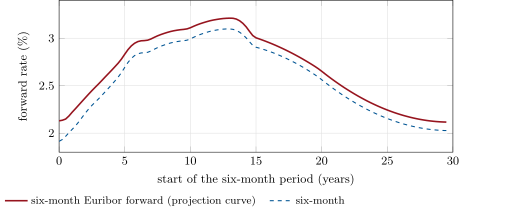
Forward rates for six-month periods from the two euro curves of . The gap is the forward tenor basis: about 22 basis points on the first period, 12 after ten years, 9 at the long end. Data: the chapter’s illustrative curves and tutorial.
Figure 2.1. Forward rates for six-month periods from the two euro curves of Example 2.5. The gap is the forward tenor basis: about 22 basis points on the first period, 12 after ten years, 9 at the long end. Data: the chapter’s illustrative curves and tutorial.

أمثلة

Example 2.5 (A euro market)

Take illustrative €STR swap rates from 1.95% at one year to 2.55% at ten and 2.60% at thirty, and six-month Euribor swap rates 20 basis points higher at one year, 15 at ten and 12 at thirty, with a six-month fixing of 2.13%. The projection curve reprices all ten Euribor instruments; by Proposition 2.2 the tenor basis is 20, 15 and 12 basis points at one, ten and thirty years. The forward basis, fixing by fixing (Figure 2.1), is 21.6 basis points on the first six-month period and 11.8 on the period starting in ten years: a par basis is an average of forward bases.

Example 2.6 (One swap, two frameworks)

A receiver of 3.50% against six-month Euribor for ten years on EUR 100 million, with the ten-year Euribor swap at 2.70%, is worth EUR 7 135 408 in the multi-curve framework and EUR 7 075 108 on a single curve built from the Euribor swaps, which discounts at the higher Euribor rates. Both frameworks agree on the par rate, 2.70%, because each is calibrated to it; they disagree by EUR 60 300 on an off-market swap.

اقرأ في الفصل →