 المدرب
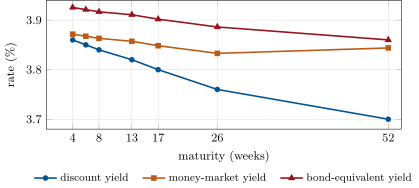
For a bill with days to maturity and price per 100 of face value: the discount yield (bank discount basis) is the discount expressed on the face value over a 360-day year, ; the money-market yield is simple interest on the amount paid over a 360-day year, the rate of a deposit of the same term; the bond-equivalent yield (the Treasury’s investment rate) is the same on a 365-day year, with , or 366 if the year after issue contains a 29 February, for bills of at most half a year; beyond half a year it solves
a semiannual compounding that makes it comparable with the yield of a coupon bond (Chapter 3).
أمثلة
Example 2.4 (A thirteen-week bill)
A 91-day bill auctioned at a discount rate of 3.82% costs per 100. Its money-market yield is 3.8572% and its bond-equivalent yield 3.9108%: nine basis points separate the number on the auction screen from the number to compare with a Treasury note. The formulas are the Treasury’s own, and they reproduce its published examples to the last digit (Section 2.6).