
सभी किताबें

पेशेवर

1 Markets I: The Ecosystem and Exchange-Traded Marketsबाज़ार ऑनलाइन 2 Markets II: Rates, FX and Creditबाज़ार ऑनलाइन 3 Markets III: Commodities, Energy and Cryptoबाज़ार ऑनलाइन 4 Quantitative Methodsविधियाँ ऑनलाइन 5 Derivatives and Volatilityडेरिवेटिव्स ऑनलाइन 6 Rates, Credit, XVA and Riskब्याज दरें, क्रेडिट और जोखिम ऑनलाइन 7 Research Craft: Predictors, Backtests, Measurement, Portfoliosअनुसंधान ऑनलाइन 8 Strategies I: Equities and Futuresरणनीतियाँ ऑनलाइन 9 Strategies II: Volatility, Relative Value, Macro and the Bank Desksरणनीतियाँ ऑनलाइन 10 Microstructure and Executionनिष्पादन ऑनलाइन 11 Market Making and High-Frequency Tradingमार्केट मेकिंग ऑनलाइन 12 Machine Learning for Marketsमशीन लर्निंग ऑनलाइन 13 Low-Latency Softwareतकनीक ऑनलाइन 14 Networks, Hardware and Trading Infrastructureतकनीक ऑनलाइन 15 Research, Data and Risk Platformsतकनीक ऑनलाइन 16 The Desk and the Firmफ़र्म ऑनलाइन 17 The Industry: Firms, Roles and Careersकरियर ऑनलाइन 18 Interviews I: Maths, Probability and Speedकरियर ऑनलाइन 19 Interviews II: Markets, Trading Games and the Final Roundकरियर ऑनलाइन 20 Interviews III: Codeकरियर ऑनलाइन
ऐप्स परिचय Coach लॉग इन पढ़ना शुरू करें

Quantitative Finance · शब्दावली

Discount, money-market and bond-equivalent yields क्या है?

अन्य नाम: discount yield · money-market yield · bond-equivalent yield

Definition 2.2 Markets II: Rates, FX and Credit · अध्याय 2 — Money Markets

For a bill with tt days to maturity and price PP per 100 of face value: the discount yield dd (bank discount basis) is the discount expressed on the face value over a 360-day year, P=100 (1−d t/360)P = 100\,(1 - d\,t/360); the money-market yield m=100−PP360tm = \frac{100 - P}{P}\frac{360}{t} is simple interest on the amount paid over a 360-day year, the rate of a deposit of the same term; the bond-equivalent yield ii (the Treasury’s investment rate) is the same on a 365-day year, i=100−PPyti = \frac{100 - P}{P}\frac{y}{t} with y=365y = 365, or 366 if the year after issue contains a 29 February, for bills of at most half a year; beyond half a year it solves

P[1+(t−y2)iy](1+i2)=100,P\Bigl[1 + \Bigl(t - \frac y2\Bigr)\frac{i}{y}\Bigr]\Bigl(1 + \frac i2\Bigr) = 100,

a semiannual compounding that makes it comparable with the yield of a coupon bond (Chapter 3).
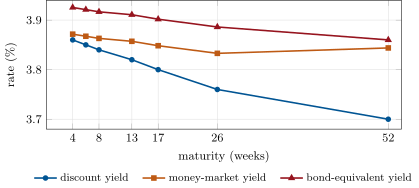
One illustrative bill curve (the seven auctioned maturities) in the three conventions. Discount yields fall steadily with maturity; money-market yields do not, because the gap between them widens with the term: the 52-week bill yields more than the 26-week in that convention. Only the bond-equivalent curve can be joined to the coupon curve. Levels are illustrative, not quotes. Data: the chapter’s tutorial.
Figure 2.1. One illustrative bill curve (the seven auctioned maturities) in the three conventions. Discount yields fall steadily with maturity; money-market yields do not, because the gap between them widens with the term: the 52-week bill yields more than the 26-week in that convention. Only the bond-equivalent curve can be joined to the coupon curve. Levels are illustrative, not quotes. Data: the chapter’s tutorial.

उदाहरण

Example 2.4 (A thirteen-week bill)

A 91-day bill auctioned at a discount rate of 3.82% costs 100(1−0.0382×91/360)=99.034389100(1 - 0.0382 \times 91/360) = 99.034389 per 100. Its money-market yield is 3.8572% and its bond-equivalent yield 3.9108%: nine basis points separate the number on the auction screen from the number to compare with a Treasury note. The formulas are the Treasury’s own, and they reproduce its published examples to the last digit (Section 2.6).

अध्याय में पढ़ें →