
جميع الكتب

مهني

1 Markets I: The Ecosystem and Exchange-Traded Marketsالأسواق عبر الإنترنت 2 Markets II: Rates, FX and Creditالأسواق عبر الإنترنت 3 Markets III: Commodities, Energy and Cryptoالأسواق عبر الإنترنت 4 Quantitative Methodsالأساليب عبر الإنترنت 5 Derivatives and Volatilityالمشتقات عبر الإنترنت 6 Rates, Credit, XVA and Riskالفائدة والائتمان والمخاطر عبر الإنترنت 7 Research Craft: Predictors, Backtests, Measurement, Portfoliosالبحث عبر الإنترنت 8 Strategies I: Equities and Futuresالاستراتيجيات عبر الإنترنت 9 Strategies II: Volatility, Relative Value, Macro and the Bank Desksالاستراتيجيات عبر الإنترنت 10 Microstructure and Executionالتنفيذ عبر الإنترنت 11 Market Making and High-Frequency Tradingصناعة السوق عبر الإنترنت 12 Machine Learning for Marketsتعلم الآلة عبر الإنترنت 13 Low-Latency Softwareالتكنولوجيا عبر الإنترنت 14 Networks, Hardware and Trading Infrastructureالتكنولوجيا عبر الإنترنت 15 Research, Data and Risk Platformsالتكنولوجيا عبر الإنترنت 16 The Desk and the Firmالشركة عبر الإنترنت 17 The Industry: Firms, Roles and Careersالمسارات المهنية عبر الإنترنت 18 The Interview Bookالمسارات المهنية عبر الإنترنت
التطبيقات حول المدرب تسجيل الدخول ابدأ القراءة

Quantitative Finance · المسرد

ما معنى Dissemination fairness؟

Definition 12.3 Networks, Hardware and Trading Infrastructure · الفصل 12 — The Asia-Pacific Map

Dissemination fairness is the property of a market-data distribution that recipients in the same service receive each message at the same time, up to a spread that does not depend on who they are: measured by the spread of receive times for one message and by whether the order of recipients persists from one message to the next.
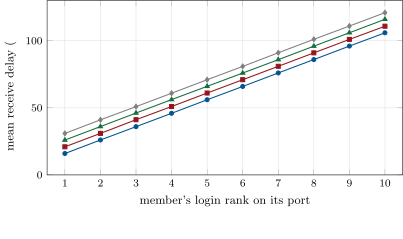
Simulation, not a measurement of any venue: mean receive delay of a tick by the member’s login rank on its port, for the four busy servers of the model (three ports of ten members each; 5\, µ s per copy at the centre, 10\, µ s per copy at a port, exponential jitter of mean 1\, µ s; 200 ticks). Each member’s delay is fixed by two login orders. Data: fig_asia.py, nw_asia.rank_curve().
Figure 12.3. Simulation, not a measurement of any venue: mean receive delay of a tick by the member’s login rank on its port, for the four busy servers of the model (three ports of ten members each; 5 µs5\,\text{µ}\mathrm{s} per copy at the centre, 10 µs10\,\text{µ}\mathrm{s} per copy at a port, exponential jitter of mean 1 µs1\,\text{µ}\mathrm{s}; 200 ticks). Each member’s delay is fixed by two login orders. Data: fig_asia.py, nw_asia.rank_curve().
DesignFirstMedianSpreadRankFirst beats
(µs\text{µ}\mathrm{s})(µs\text{µ}\mathrm{s})(µs\text{µ}\mathrm{s})correlationmedian
Unicast, fixed login order16.065.6107.71.00100%
Unicast, randomised15.170.7110.20.0788%
Unicast, randomised, no secondary15.269.0106.90.0151%
Multicast10.010.78.4–50%
Table 12.2. Simulation of four dissemination designs (the parameters of Figure 12.3; 126 members, of whom six on the secondary server, which the fourth design closes): one tick’s first, median and spread of receive times, the rank correlation between consecutive ticks, and how often the member first on one tick beats the median member of that tick over the next 200 ticks, both reacting in 20 µs20\,\text{µ}\mathrm{s} with a standard deviation of 5 µs5\,\text{µ}\mathrm{s}. Data: nw_asia.scenarios().
اقرأ في الفصل →