
सभी किताबें

पेशेवर

1 Markets I: The Ecosystem and Exchange-Traded Marketsबाज़ार ऑनलाइन 2 Markets II: Rates, FX and Creditबाज़ार ऑनलाइन 3 Markets III: Commodities, Energy and Cryptoबाज़ार ऑनलाइन 4 Quantitative Methodsविधियाँ ऑनलाइन 5 Derivatives and Volatilityडेरिवेटिव्स ऑनलाइन 6 Rates, Credit, XVA and Riskब्याज दरें, क्रेडिट और जोखिम ऑनलाइन 7 Research Craft: Predictors, Backtests, Measurement, Portfoliosअनुसंधान ऑनलाइन 8 Strategies I: Equities and Futuresरणनीतियाँ ऑनलाइन 9 Strategies II: Volatility, Relative Value, Macro and the Bank Desksरणनीतियाँ ऑनलाइन 10 Microstructure and Executionनिष्पादन ऑनलाइन 11 Market Making and High-Frequency Tradingमार्केट मेकिंग ऑनलाइन 12 Machine Learning for Marketsमशीन लर्निंग ऑनलाइन 13 Low-Latency Softwareतकनीक ऑनलाइन 14 Networks, Hardware and Trading Infrastructureतकनीक ऑनलाइन 15 Research, Data and Risk Platformsतकनीक ऑनलाइन 16 The Desk and the Firmफ़र्म ऑनलाइन 17 The Industry: Firms, Roles and Careersकरियर ऑनलाइन 18 Interviews I: Maths, Probability and Speedकरियर ऑनलाइन 19 Interviews II: Markets, Trading Games and the Final Roundकरियर ऑनलाइन 20 Interviews III: Codeकरियर ऑनलाइन
ऐप्स परिचय Coach लॉग इन पढ़ना शुरू करें

Quantitative Finance · शब्दावली

Dissemination fairness क्या है?

Definition 12.3 Networks, Hardware and Trading Infrastructure · अध्याय 12 — The Asia-Pacific Map

Dissemination fairness is the property of a market-data distribution that recipients in the same service receive each message at the same time, up to a spread that does not depend on who they are: measured by the spread of receive times for one message and by whether the order of recipients persists from one message to the next.
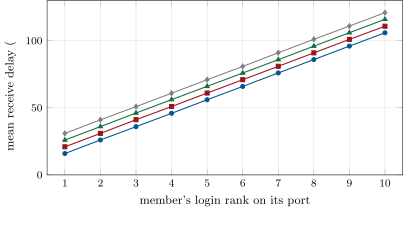
Simulation, not a measurement of any venue: mean receive delay of a tick by the member’s login rank on its port, for the four busy servers of the model (three ports of ten members each; 5\, µ s per copy at the centre, 10\, µ s per copy at a port, exponential jitter of mean 1\, µ s; 200 ticks). Each member’s delay is fixed by two login orders. Data: fig_asia.py, nw_asia.rank_curve().
Figure 12.3. Simulation, not a measurement of any venue: mean receive delay of a tick by the member’s login rank on its port, for the four busy servers of the model (three ports of ten members each; 5 µs5\,\text{µ}\mathrm{s} per copy at the centre, 10 µs10\,\text{µ}\mathrm{s} per copy at a port, exponential jitter of mean 1 µs1\,\text{µ}\mathrm{s}; 200 ticks). Each member’s delay is fixed by two login orders. Data: fig_asia.py, nw_asia.rank_curve().
DesignFirstMedianSpreadRankFirst beats
(µs\text{µ}\mathrm{s})(µs\text{µ}\mathrm{s})(µs\text{µ}\mathrm{s})correlationmedian
Unicast, fixed login order16.065.6107.71.00100%
Unicast, randomised15.170.7110.20.0788%
Unicast, randomised, no secondary15.269.0106.90.0151%
Multicast10.010.78.4–50%
Table 12.2. Simulation of four dissemination designs (the parameters of Figure 12.3; 126 members, of whom six on the secondary server, which the fourth design closes): one tick’s first, median and spread of receive times, the rank correlation between consecutive ticks, and how often the member first on one tick beats the median member of that tick over the next 200 ticks, both reacting in 20 µs20\,\text{µ}\mathrm{s} with a standard deviation of 5 µs5\,\text{µ}\mathrm{s}. Data: nw_asia.scenarios().
अध्याय में पढ़ें →